
“`json
{
“title”: “🥣 Better Than a Konbini Breakfast: Why Standing Soba Is the Smart Traveler’s Ultimate Morning Hack”
}
“`
🥣 Better Than a Konbini Breakfast: Why Standing Soba Is the Smart Traveler’s Ultimate Morning Hack
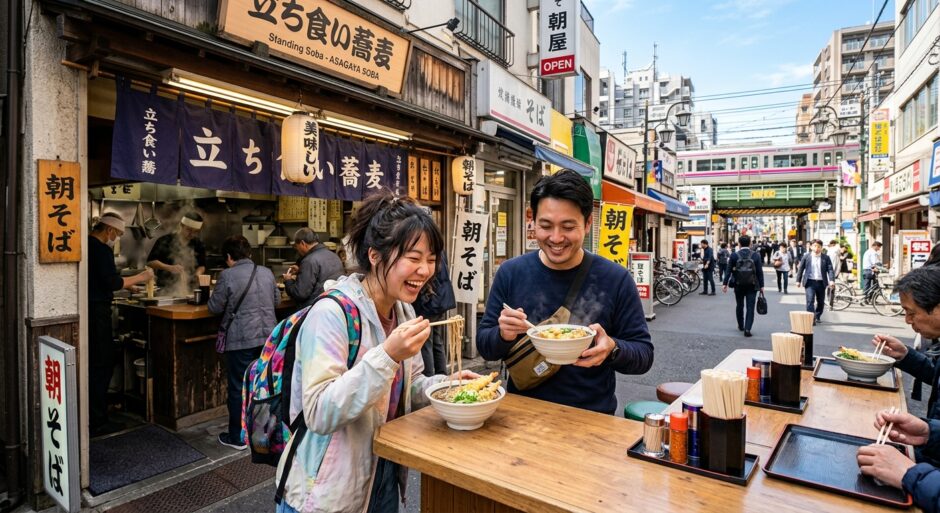
You’ve seen them at every major train station in Tokyo, Osaka, and beyond: small, steam-filled shops where salarymen are hunched over bowls of noodles, slurping at lightning speed before vanishing into the morning commute. To the uninitiated, Tachigui Soba (standing soba) looks like a frantic pit stop. To the smart traveler, it’s the ultimate life hack for a high-energy, low-cost day in Japan. 🌸🏯🍜
📊 Japan Hacks: Morning Soba Dashboard
🕒 Speed: 3-5 Minutes (Ultra Fast)
💰 Price: ¥380 – ¥550 ($2.50 – $4.00)
🥗 Health Factor: High (Buckwheat & Protein)
Difficulty Meter:
Ordering via ticket machine is the only “hurdle”!
⚔️ The Great Breakfast Battle: Konbini vs. Standing Soba
Don’t get us wrong—we love a 7-Eleven egg salad sandwich. But if you rely on convenience store bread and rice balls every single morning, you’re missing out on a vital piece of Japanese food culture. While a konbini breakfast is functional, a standing soba breakfast is formidable.
🚀 Speed That Defies Logic
At a busy station like Shinjuku or Umeda, a standing soba shop can serve a bowl of hot noodles in under 60 seconds. In the time it takes to queue for the microwave at Lawson, you could have finished half your bowl and be halfway to the platform.
Nutrition Comparison: Standing Soba vs. Konbini Pastry
*Based on average glycemic index and protein density.*
🍲 Why Soba is the Secret Fuel for Sightseeing
Walking 20,000 steps through Kyoto or Tokyo requires sustained energy. Soba is made from buckwheat, which has a lower glycemic index than the white bread or white rice found in most quick snacks. This means you won’t experience that 11:00 AM “sugar crash” while waiting in line at the Ghibli Museum.
✨ The “Soba-yu” Magic
Here is a Japan Hack most tourists miss: If you order mori soba (cold noodles), don’t just walk away when you’re done. Look for a red teapot or a thermos labeled Soba-yu (そば湯). This is the water used to boil the noodles, packed with vitamin B and nutrients. Pour it into your remaining dipping sauce to create a savory, comforting soup to finish your meal.
💡 Pro-Tip: The “Morning Set” (Asa-setto)
Look for the characters 朝食 (Choshoku) or 朝セット (Asa-setto) on the ticket machine. These are special morning deals (usually available until 10 AM) that often include a half-bowl of soba AND a small rice bowl with an egg or tempura for under ¥500!
🚉 Real-World Scenario: The Shinjuku Sprint
Imagine you have a 7:30 AM Limited Express train to Matsumoto. You haven’t eaten. You could grab a cold sandwich, but instead, you stop at Fuji Soba near the West Exit.
In a manufacturing plant environment in Aichi, workers often start their day with a warm, broth-based meal to stimulate digestion and focus. By choosing soba over a sugary pastry, you’re adopting the same local efficiency. You sit (or stand) for 5 minutes, consume a nutrient-dense meal, and board your train feeling warm, full, and sharp. That is Omotenashi you give to yourself.
| Feature | Konbini Breakfast | Standing Soba |
|---|---|---|
| Dining Experience | Eating on a bench or train | Authentic “local” atmosphere |
| Temperature | Cold or Microwaved | Freshly Boiled / Steaming Hot |
| Customization | Limited to shelf stock | Add eggs, tempura, or ginger |
🛑 Manner Alert: The Golden Rules of the Counter
🚩 Manner Alert!
- Clear Your Own Tray: When finished, place your bowl on the return counter (usually labeled 返却口 – Henkyaku-guchi).
- No Lingering: These shops are built for turnover. Once the last drop is gone, head out to make room for the next person.
- Slurp Away: Slurping isn’t just allowed; it’s the best way to cool the noodles and aerate the broth!
🤖 Navigating the Ticket Machine
Most shops use a vending machine at the entrance. Don’t panic if it’s all in Japanese! Most machines have photos. If they don’t, here are the three buttons you need to know:
- かけそば (Kake Soba): Basic hot soba in broth.
- もりそば (Mori Soba): Cold noodles with dipping sauce.
- 天ぷら (Tempura): Usually “Kakiage” (vegetable fritter).
🤔 Frequently Asked Questions
Q: Are there vegetarian options at standing soba shops?
A: It’s tricky. While the noodles are buckwheat, the broth (dashi) almost always contains fish flakes (katsuobushi). If you are strict vegetarian, konbini onigiri (plum or kelp) might be safer.
Q: Do I need cash for the ticket machines?
A: Most modern station soba shops (like Irori-an Kiraku) accept IC cards like Suica or Pasmo. Smaller street-side shops may still be cash-only (coins/¥1000 notes).
Q: Is “Standing Soba” always standing?
A: Not anymore! Many chains like Fuji Soba now provide stools. However, the name “Tachigui” remains a symbol of the speed and style of service.
Next time you’re about to grab a cold pastry from the station kiosk, look around for the noren curtains of a soba shop. It’s cheaper, healthier, faster, and gives you a front-row seat to the daily rhythm of Japanese life.