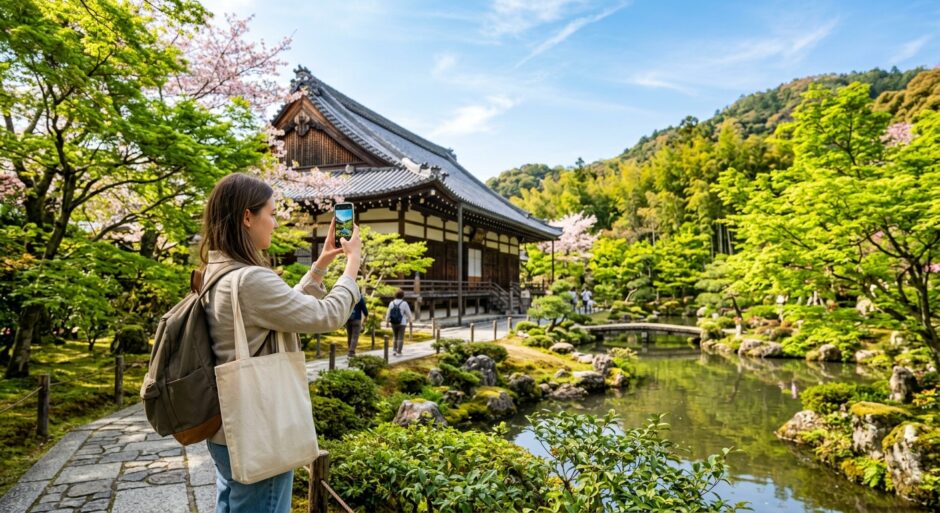

“`json
{
“title”: “7 Pro Smartphone Hacks for Capturing Professional Japan Travel Photos Without a DSLR”,
“description”: “Learn how to capture stunning, professional-grade Japan travel photos using only your smartphone. From night mode in Shinjuku to vertical panoramas in Kyoto.”,
“category”: “Travel Tips”,
“tags”: [
“Japan Photography”,
“Smartphone Hacks”,
“Travel Guide”,
“Japan Travel Tips”,
“Photography Gear”
]
}
“`
7 Pro Smartphone Hacks for Capturing Professional Japan Travel Photos Without a DSLR 📸
Japan is arguably the most photogenic country on Earth. From the neon-drenched alleys of Shinjuku to the mossy, silent shrines of Kyoto, every corner feels like a movie set. But here’s the secret: You don’t need a bulky $3,000 DSLR to capture the magic. 🌸
In fact, a smartphone is often better for “Japan Hacks” style travel. It’s discreet, fits in your pocket while you’re slurping ramen, and is always ready for that fleeting moment when a Geisha turns a corner in Gion. As the Creative Director of Japan Hacks, I’ve spent years testing mobile sensors against the Japanese landscape.
📊 Japan Hacks Photo Dashboard
Difficulty Level: Beginner to Intermediate
Essential Gear: Smartphone, Microfiber cloth, Lightweight Power Bank
Best Time for Photos: Blue Hour (20 mins after sunset)
Technique Impact Score:
95% – High professional look achieved
1. 🏮 Harness the “Cyberpunk” Glow (Night Mode Secrets)
Japan comes alive at night. To capture those glowing lanterns and neon signs without them looking like a blurry mess, you need to master Night Mode.
The Pro Hack: Don’t just point and shoot. Tap on the brightest part of the screen (the neon sign) and slide the “sun” icon down to decrease exposure. This preserves the colors of the neon while keeping the shadows deep and moody.
💡 Pro-Tip: In Omoide Yokocho (Piss Alley) in Shinjuku, look for steam rising from yakitori stalls. Position your phone so the steam is backlit by a lantern. It creates a cinematic “Blade Runner” effect that looks professional instantly.
2. ⛩️ Use Leading Lines at Torii Gates
The Fushimi Inari Shrine is a masterpiece of “Leading Lines”—a photography technique that pulls the viewer’s eye into the frame.
The Pro Hack: Get low. Instead of shooting from eye level, crouch down and hold your phone near the ground. This makes the orange pillars look more imposing and creates a sense of endless depth.
3. 🏙️ The “Vertical Panorama” for Skyscrapers and Pagodas
Struggling to fit the Tokyo Skytree or a 5-story pagoda into one frame? Standard wide-angle lenses often distort the edges.
The Pro Hack: Use the Pano Mode, but turn your phone horizontally. Start at the base of the building and move the phone upwards in a smooth arc. This “Vertipan” technique captures the scale of Japanese architecture without the weird fisheye distortion of a 0.5x lens.
Japanese Word of the Day
木漏れ日
Komorebi
“The sunlight that filters through the leaves of trees.” (Perfect for your Arashiyama Bamboo Grove captions!)
4. ⏳ “Ghost” the Crowds in Shibuya
Shibuya Crossing is legendary, but sometimes you want a photo where the crowds are a beautiful blur of motion while the buildings stay sharp.
The Pro Hack: Use Live Photo (iPhone) or Motion Photo (Android). After taking the shot of the busy crossing, swipe up on the photo in your gallery and select “Long Exposure.” The software will magically blur everyone moving, leaving you with a professional “time-lapse” style still.
5. 🍜 Macro Mode for “Food Porn” Perfection
Japanese food is art. Whether it’s the marbling on wagyu or the glisten of fresh fatty tuna, detail is everything.
| Feature | Standard Shot | Macro Hack |
|---|---|---|
| Focus | General background | Extreme texture detail |
| Lighting | Often flat | Uses side-light for depth |
| The “Vibe” | Tourist snap | Michelin-guide style |
6. 🎞️ The “Muted Japan” Color Palette
If you look at professional Japan travel photography, the colors are often slightly desaturated with a hint of teal in the shadows and cream in the highlights.
The Pro Hack: Don’t use the standard vivid filters. Download **Lightroom Mobile** (Free). Drop the “Saturation” slightly, but increase the “Vibrance.” Then, slightly lift the “Blacks” in the Curve tool. This creates that airy, minimalist “Muji” aesthetic that feels authentically Japanese.
7. 💧 Reflection Magic in the Rain
Rainy days in Japan are a blessing for photographers. The wet asphalt acts as a giant mirror for neon lights.
The Pro Hack: Flip your phone upside down. By putting the camera lens as close to a puddle as possible, you create a perfectly symmetrical reflection shot. This works incredibly well in Dotonbori, Osaka, with the Glico Man sign.
🚨 Manner Alert: Photography Etiquette
Japan has strict privacy laws. In many temples (like the inside of Sanjusangendo in Kyoto) and certain streets in Gion, photography is strictly prohibited. Always look for the “No Photos” sign. Additionally, if you are using a Japanese smartphone, the shutter sound cannot be turned off—be mindful of this in quiet, sacred spaces!
Real-World Scenario: The “Blue Hour” in Aichi
In a manufacturing-heavy area like Toyota City in Aichi, I once spent an evening trying to capture the contrast between industrial architecture and the setting sun. By using Hack #1 (Night Mode) combined with a 2-second timer (to avoid hand-shake), I was able to capture the factory lights reflecting off the river with clarity that surpassed a tourist’s entry-level DSLR. The key was the stability—even leaning your phone against a vending machine can act as a DIY tripod!
🤔 Frequently Asked Questions
Q: Is it okay to take photos of people in Japan?
A: Generally, it is best to avoid taking clear photos of strangers’ faces without permission. Japanese people value privacy highly. For street photography, try to capture silhouettes or shots from behind to stay respectful.
Q: Do I need an external lens attachment for my phone?
A: Not necessarily. Modern smartphones have excellent wide and telephoto lenses built-in. Your money is better spent on a high-quality editing app like Lightroom or a portable power bank to keep your phone alive all day.
Japan is a land of details. Look for the small things—the way a tea cup sits on a wooden table, the moss between temple stones, or the symmetry of a train station. Your smartphone is the perfect tool to document it all.