
“`json
{
“title”: “Avoid the 24-Hour Trap: How to Master Japan’s Complex Maximum Parking Rate Rules”
}
“`
Imagine this: You’ve just spent a magical day exploring the neon-lit streets of Osaka or the historic temples of Kyoto. You found a perfect parking spot with a big sign that shouted “Maximum ¥1,000 / 24 Hours.” 🚗💨 You leave your car for two days, expecting a bill of ¥2,000. But when you insert your ticket, the machine demands ¥12,800. 😱
Welcome to the “24-Hour Trap.” Japanese parking lots are masters of fine print, and without knowing how to read the “Repeating” vs. “One-time” rules, your road trip budget can vanish in seconds. Let’s dive into the secret world of Japanese coin parking so you can spend your yen on sushi, not asphalt. 🍣🍱
📊 Japan Hacks Parking Dashboard
Difficulty Meter:
85% – Complex fine print!
- 📍 Key Area: Urban centers (Tokyo, Osaka, Nagoya)
- 💡 Crucial Hack: Look for “Repeating” (Kurikaeshi)
- 💸 Potential Savings: Up to ¥15,000 per weekend
Avoid the 24-Hour Trap: How to Master Japan’s Complex Maximum Parking Rate Rules 🛑
Parking in Japan is incredibly convenient, but the logic behind the pricing is unique. Most “Coin Parking” (unmanned lots) offer a maximum rate (Saidai Ryōkin). However, this maximum is often subject to hidden conditions that only trigger after the first 24 hours.
🏗️ The Core Problem: “One-Time” vs. “Repeating”
This is where most travelers get burned. There are two types of maximum rates in Japan:
- One-time Maximum (1回限り): The maximum rate applies only to the *first* 24 hours (or the first calendar day). After that, the meter resets to the standard hourly rate, which can be as high as ¥600 every 15 minutes in places like Ginza.
- Repeating Maximum (繰り返し適用): The maximum rate applies every 24 hours for as long as you stay.
💰 The Cost of the “One-Time” Trap (48-Hour Stay)
¥2,000
¥14,000+
*Assuming ¥400/30 min after the first 24 hours.
🚨 E-E-A-T Real-World Case Study: The Kyoto Station Disaster
To illustrate the severity, let’s look at a common scenario we’ve seen near Kyoto Station. A rental car user parked in a lot labeled “¥1,200 for 24 hours.” They assumed three days of parking would cost ¥3,600.
However, the sign had small text stating “Saidai Ryōkin wa ichido-kiri” (Maximum rate applies only once).
- Day 1: ¥1,200 (Max applied)
- Day 2: ¥19,200 (¥400 every 30 mins, 24 hours)
- Day 3: ¥19,200
- Total Bill: ¥39,600 (Approx. $265 USD)
A simple misunderstanding of one kanji phrase turned a budget-friendly parking choice into the most expensive part of their trip!
💡 Japan Hacks Pro-Tip
Use the “Times 24” or “Mitsui Repark” apps. They allow you to filter by “Repeating Maximum Rate” and even show real-time availability. Most importantly, they translate the rules into clearer UI elements than the physical signs!
📖 How to Read a Japanese Parking Sign Like a Local
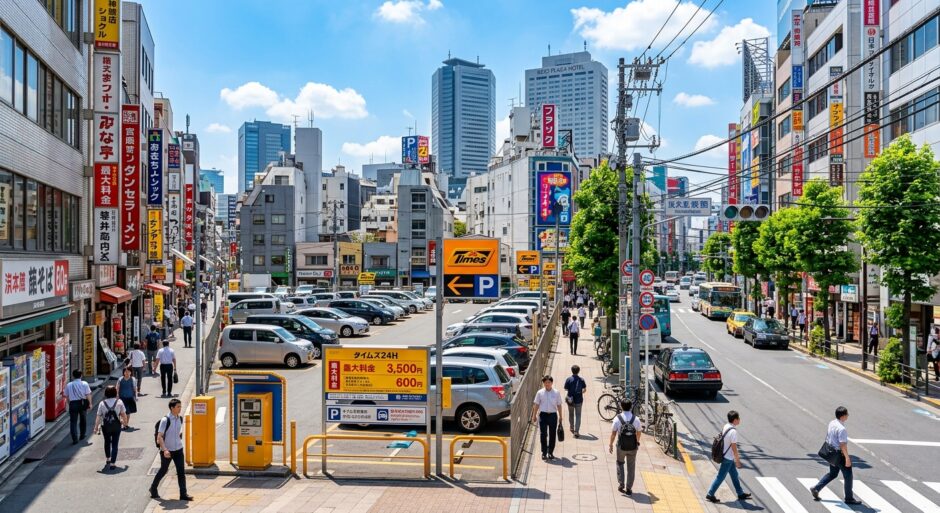
When you pull up to a lot, don’t just look at the big numbers. Look for these specific visual cues:
🏙️ The “Calendar Day” vs. “24 Hour” Distinction
Some lots use a “Midnight Reset” system. If the sign says “Daily Maximum ¥1,000” but doesn’t mention “24 hours,” it might reset at 12:00 AM.
If you park at 11:00 PM and leave at 1:00 AM, you’ve parked for 2 hours, but you will be charged for two calendar days (¥2,000). Always look for the specific phrase “入庫後24時間” (24 hours after entry) to ensure you get a full 24-hour block.
📢 Manner Alert: Parking Etiquette
In Japan, reversing into a parking spot is the standard. It is safer for pedestrians and allows for a quicker exit. However, some lots near residential areas have signs that say “Maemuki Chusha” (前向き駐車)—this means “Head-in Parking Only” to prevent exhaust fumes and noise from disturbing neighbors. Always check for this sign to avoid a polite but firm scolding!
❓ Frequently Asked Questions
Q: What should I do if I lose my parking ticket?
A: Look for the “Lost Ticket” (紛失 – Funshitsu) button on the machine. You will usually be charged a flat penalty fee, often between ¥3,000 and ¥10,000, regardless of how long you stayed. It’s painful, so keep that ticket in your sun visor!
Q: Do coin parking machines take credit cards?
A: Major chains like Times 24 and Mitsui Repark usually do, but many smaller, independent lots are cash only (¥1,000 bills and coins). Always carry a few ¥1,000 notes before entering a small lot.
Q: Can I park overnight in a lot that doesn’t mention a maximum rate?
A: Yes, but be extremely careful. Without a “Maximum” (Saidai), the hourly rate continues to stack indefinitely. You could easily wake up to a ¥10,000+ bill.
Final Verdict: The Golden Rule 🏆
If you are planning to park for more than 24 hours, **never assume the rate will repeat.** Look for the words “繰り返し” (Kurikaeshi). If you don’t see them, the safest move is to drive the car out of the lot after 23 hours and 59 minutes, then immediately drive back in. This “resets” the transaction and guarantees you get the maximum rate for the next 24-hour block.
Parking in Japan doesn’t have to be a gamble. By reading the signs and understanding the “Trap,” you’re now equipped to explore the Japanese countryside and cityscapes with total peace of mind.