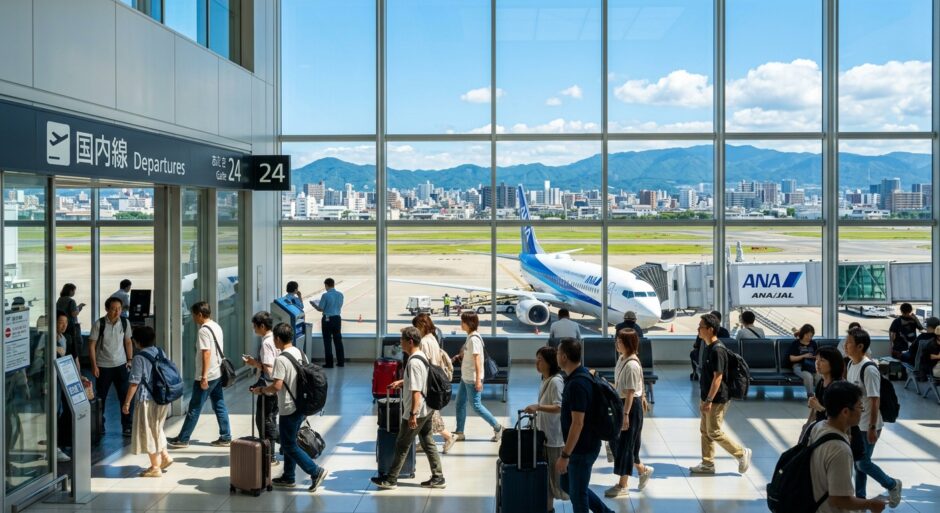

“`json
{
“title”: “Why You Shouldn’t Book Japan Domestic Flights Like a Tourist: 5 Common Pitfalls to Avoid”,
“description”: “Stop overpaying for domestic flights in Japan! Learn the insider secrets to booking cheap tickets, avoiding transit traps, and mastering the local aviation landscape like a Japan Hacks pro.”,
“keywords”: “Japan domestic flights, JAL Explorer Pass, ANA Experience Japan, Japan travel tips, flying in Japan, Narita vs Haneda, Japan budget travel, Shinkansen vs flying”
}
“`
Think flying across Japan is as simple as clicking “Book” on Expedia? Think again. If you book like a typical tourist, you’re likely flushing thousands of yen down the drain and wasting hours in airport security lines that you could have spent eating ramen in Fukuoka. 🍜✈️
Why You Shouldn’t Book Japan Domestic Flights Like a Tourist: 5 Common Pitfalls to Avoid
Welcome to Japan Hacks! We aren’t here to give you the standard travel brochure advice. We’re here to make you travel like a local who knows every shortcut, discount, and hidden rule in the book. Japan’s domestic aviation market is one of the most unique in the world—highly efficient, incredibly punctual, but riddled with “insider-only” pricing that most tourists never see.
📊 Japan Domestic Flight Dashboard
Booking Complexity
Moderate
Potential Savings
Up to 70%
Best Booking Window
30–60 Days
🚀 Pitfall #1: Paying “Global” Prices on Third-Party Sites
The biggest mistake tourists make is using global aggregators like Skyscanner or Expedia and assuming the price they see is the best one. In Japan, the two giants—JAL (Japan Airlines) and ANA (All Nippon Airways)—offer specialized **Foreigner Fares** that are hidden from standard search results.
For instance, the **JAL Explorer Pass** and the **ANA Experience Japan Fare** often offer fixed-rate tickets for as low as ¥5,500 to ¥11,000 ($35–$75 USD) for any domestic leg. Whether you’re flying from Tokyo to Osaka or Tokyo to the northern tip of Hokkaido, the price stays the same.
🎒 Pitfall #2: Forgetting the “Hidden Costs” of LCCs
Japan has excellent Low-Cost Carriers (LCCs) like **Peach Aviation**, **Jetstar Japan**, and **Spring Airlines**. While their base fares are enticingly low, tourists often get stung by rigid rules. Unlike the full-service JAL/ANA foreigner fares (which include 2 checked bags), LCCs charge for everything.
⚠️ Manner Alert: The LCC Weight Trap
Japanese LCCs are notorious for weighing carry-on bags at the gate. If your combined weight exceeds 7kg (often the limit), you will be forced to pay a “Gate Check-in Fee,” which can sometimes be more expensive than the flight ticket itself. Always pre-book your luggage online!
国内線
Kokunaisen
Literally: “Domestic Flight.” Look for this kanji at the airport to find the correct terminal!
🚉 Pitfall #3: Ignoring the “Door-to-Door” Time Reality
A flight from Tokyo to Osaka is only 60 minutes in the air. Seems faster than the 2.5-hour Shinkansen (Bullet Train), right? **Wrong.**
When you factor in getting to Haneda or Narita airport, arriving 60 minutes early for security, and then taking the train from Itami or Kansai Airport into central Osaka, the “1-hour flight” actually takes closer to 4.5 hours.
Total Travel Time: Tokyo to Osaka (City Center to City Center)
2 hrs 45 mins
4 hrs 15 mins
*Includes average train time to/from airports and security wait times.
🏢 Pitfall #4: Landing at the Wrong Airport (Narita vs. Haneda)
In the Tokyo area, tourists often book the cheapest flight without realizing it departs from **Narita (NRT)** instead of **Haneda (HND)**.
Haneda is located just 15-20 minutes from central Tokyo (Shinagawa/Hamamatsucho). Narita is 60-90 minutes away and costs roughly ¥3,000 ($20) per person just to reach. If your flight from Narita is $30 cheaper than Haneda, you haven’t saved money—you’ve just lost two hours of your life and broken even on the train fare.
💡 Japan Hacks Pro-Tip
Use the “Haneda Rule.” Always prioritize Haneda for domestic travel. Even if the ticket is slightly more expensive, the convenience and savings on airport transfer costs almost always make it the superior choice. The same applies to Itami (ITM) vs. Kansai (KIX) in Osaka—Itami is much closer to the city!
⏰ Pitfall #5: Missing the “15-Minute Rule”
In many Western countries, domestic boarding is a bit of a free-for-all. In Japan, precision is everything. Most domestic flights have a hard cut-off: you **must** pass through the security checkpoint no later than **20 minutes** before departure, and be at the gate **10-15 minutes** before.
Unlike in the US or Europe, if you arrive at the gate 9 minutes before a flight, the doors are likely already shut. They don’t wait. The planes push back exactly on the minute.
🌟 Real-World Scenario: The Fukuoka Sprint
“Last spring, a traveler using the JAL Explorer Pass was flying from Fukuoka to Sapporo. Because Fukuoka Airport is famously located right in the city (only 2 stops from the main station), they arrived only 30 minutes before departure. They breezed through security (which usually takes 5 minutes in Japan) and made it to the gate with 5 minutes to spare before boarding finished. Total cost? ¥5,500. Total stress? Zero. That’s the power of knowing the local system.”
🤔 Frequently Asked Questions
Q: Do I need a special ID to book Foreigner Fares?
A: Yes. You must be a non-resident of Japan and hold a foreign passport with a ‘Temporary Visitor’ visa. You will also need to provide your international ticket number during booking.
Q: Is there free Wi-Fi on Japan domestic flights?
A: Surprisingly, yes! JAL and ANA provide free Wi-Fi on most domestic routes, whereas most LCCs (like Peach) do not.
Q: Is it better to book directly on the Japanese website or the English one?
A: Always use the English “Global” site for JAL/ANA to access the special tourist passes. Local Japanese sites usually only show standard resident fares.
Flying in Japan can be a dream—clean cabins, polite staff, and stunning views of Mt. Fuji if you sit on the right side of the plane (Pro-tip: Sit on the Left side flying from Tokyo to Osaka/Okinawa!). Avoid these 5 pitfalls, and you’ll save enough money to upgrade your next dinner to Kobe beef.