
🚽 Deciphering the Icons: How to Navigate Japanese High-Tech Toilets
“Wait, which one is the flush and which one is the… oh no.” — Every traveler ever.
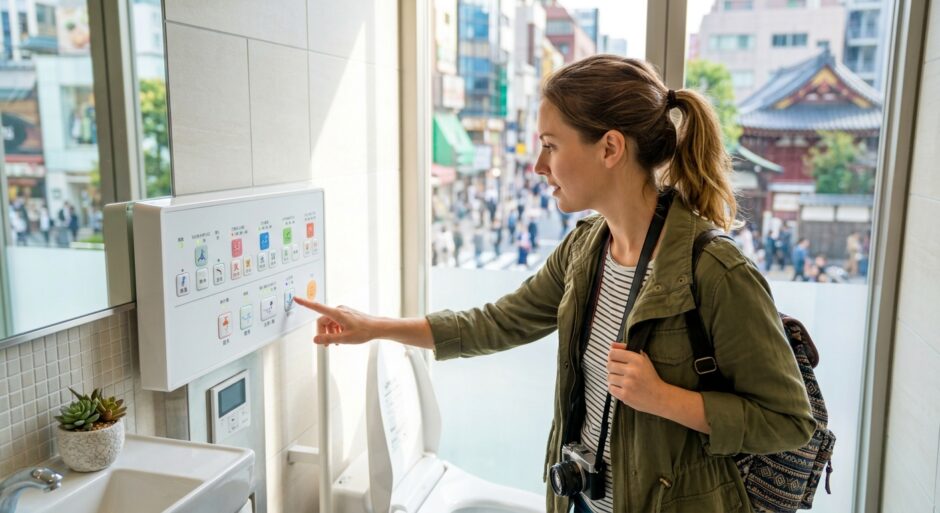
🌸 Picture this: You’ve just landed at Narita, checked into your sleek Shinjuku hotel, and you’re ready to experience the wonders of Japan. You step into the bathroom, and there it is—the legendary Japanese “Washlet.” It’s glowing. It’s heated. It has more buttons than a SpaceX cockpit. 🏯
Then, the panic sets in. Everything is in Kanji. There are icons that look like fountain pens, mountain peaks, and waves. You just want to flush, but you’re terrified you might accidentally trigger a high-pressure jet or a chorus of synthesized bird chirps. Don’t worry; we’ve all been there. Welcome to your Japan Hacks masterclass on bathroom survival.
🇯🇵 Quick Hack Summary
- ✅ The Standard: Since 2017, all major manufacturers use 8 universal icons. Look for these first!
- ✅ The Fail-Safe: The “Stop” button is almost always Square and Red/Orange.
- ✅ The Ghost Flush: If there’s no button on the panel, wave your hand over a sensor on the wall.
(Easier than it looks!)
📐 The Great Standardization of 2017
Before 2017, navigating a Japanese toilet was like playing Minesweeper. Every brand—TOTO, LIXIL, Panasonic—had its own hieroglyphics. Recognizing that tourists were accidentally soaking their shirts, the Japan Sanitary Equipment Industry Association agreed on eight universal pictograms. If you see these icons, they will always mean the same thing, regardless of the brand.
📊 Traveler Confidence Level
15%
98%
🔍 Breaking Down the “Big Four” Buttons 🌊
These are the buttons you will use 90% of the time. Memorize these shapes, and you are officially a Japan pro.
💡 Pro-Tip:
If you can’t find a flush button on the control panel, check behind you! Many modern toilets in malls and train stations use a motion sensor on the wall. Just wave your hand in front of the black glass panel.
🎶 The Advanced Settings: Sound, Air, and Heat
Once you’ve mastered the basics, you might want to customize your experience. This is where Japanese hospitality (Omotenashi) really shines. You’ll often see buttons for “Water Pressure” (Plus/Minus signs) and “Nozzle Position” (Arrows pointing up/down).
音姫
(Otohime)
Literally: “Sound Princess”
A button that plays the sound of rushing water or birds to mask any “unwanted noises.” Extremely common in women’s restrooms!
🌡️ Seat and Water Temperature
On the side of the panel, you might see the Kanji 便座 (Benza – Toilet Seat) and 水温 (Suion – Water Temp).
• 低 (Tei): Low / Cool
• 高 (Kou): High / Hot
⚠️ Manner Alert!
Never stand up while the spray is active. The sensor is usually good, but if you lift off the seat while the water is running, you risk giving yourself—and the bathroom wall—an accidental shower. Always hit the STOP button first!
🤔 What If the Panel is a Touchscreen?
In high-end department stores like Ginza Six or Isetan, you might encounter a glass touchscreen embedded in the wall. These often have an “English” button in the corner, but the icons remain the same. If the screen is dark, just sit down—the toilet uses a proximity sensor to “wake up” the panel as you approach. It’s like a personalized welcome ceremony for your arrival.
🔚 Final Thoughts: Embrace the Tech
It’s easy to feel overwhelmed, but the Japanese high-tech toilet is designed for your comfort. Once you get used to the heated seat and the precision cleaning, going back to a “standard” toilet feels like stepping back into the Stone Age. Don’t be afraid to experiment (just locate that Square Stop Button first!).
By learning these few icons, you’ve removed one of the biggest “culture shock” hurdles of traveling in Japan. Now, you can spend less time panicking in the stall and more time enjoying that bowl of Ramen you came for! 🍜