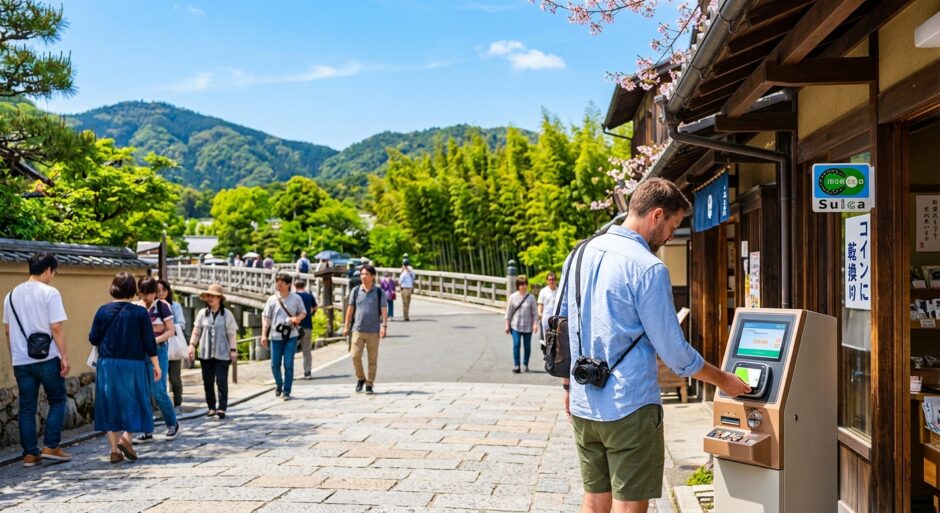

We’ve all been there. You’re standing at a Narita Airport terminal, staring at a handful of lightweight, aluminum 1-yen coins and those golden 5-yen coins with the hole in the middle. You can’t use them in vending machines. Most ticket machines reject them. Even convenience store clerks give you a slightly pained smile when you try to count out forty-seven 1-yen coins for a snack.
Traditionally, these coins end up at the bottom of a souvenir jar or, worse, in a trash can at the airport. **Stop right there!** In the modern, digital Japan, those “worthless” coins are actually hidden travel credit waiting to be unlocked.
Welcome to the ultimate **Japan Hacks** guide on turning your physical clutter into digital gold.
🇯🇵 Quick Hack Summary
- ✅ The Solution: Use “Pocket Change” kiosks located in major airports and stations.
- ✅ What it does: Converts 1-yen, 5-yen, and foreign coins into Suica, Pasmo, or Amazon credit.
- ✅ Major Benefit: Clears your wallet of weight while funding your next train ride or coffee.
(Extremely Easy)
💰 The “Small Change” Struggle: Why 1 and 5 Yen Coins are Tricky
In Japan, cash is still very much part of the ecosystem, though mobile payments are catching up. When you pay with a 1,000 yen note for a 913 yen item, you’re going to get a handful of change.
Specifically, the **1-yen coin** (Ichien) and the **5-yen coin** (Go-en) are the “orphans” of the Japanese currency system.
* **The 1-Yen:** Made of 100% aluminum. It’s so light it can float on water.
* **The 5-Yen:** Made of brass with a central hole. It’s considered “lucky” (more on that later), but functionally useless for automated machines.
Most vending machines—the lifeblood of Japanese streets—only accept 10, 50, 100, and 500 yen coins. The same goes for older bus fare boxes and many train ticket machines. This leaves tourists with “coin bloat”—a heavy wallet that feels full but lacks buying power.
小銭
(Kozeni)
“Small change” or “coins”
🤖 The Hero Emerges: Meet the “Pocket Change” Kiosk
Enter **Pocket Change**, a green-and-white kiosk that looks like a high-tech ATM. These machines are the ultimate solution for the departing traveler or the savvy resident.
Instead of painstakingly counting coins at a register, you simply dump your entire jar of mixed coins (Japanese yen, US dollars, Euros, etc.) into the machine’s hopper. The machine sorts them instantly and asks how you’d like your digital payout.
📍 Where to Find Them
You can find these machines at strategic “exit points” and high-traffic hubs:
1. **Airports:** Narita (Terminals 1 & 2), Haneda (International Terminal), Kansai International, New Chitose, and Fukuoka.
2. **Major Stations:** Shinjuku, Tokyo Station, Shibuya, and Akihabara.
3. **Retailers:** Select Don Quijote stores and BIC Camera locations.
💡 Pro-Tip:
Don’t bother sorting your coins! The Pocket Change machine can handle a mixture of Japanese Yen and other major currencies simultaneously. Just dump and go.
📲 How to Load Your Digital Suica/Pasmo
The process is surprisingly tactile and satisfying. Here is exactly how to do it:
📊 Why Use This Instead of a Bank or Store?
You might be thinking, “Can’t I just deposit these at a bank?” Or “Can’t I just buy a coffee with them?”
While you *can* do those things, the convenience factor varies wildly. In 2022, many major Japanese banks (like Mitsubishi UFJ and SMBC) introduced fees for depositing large amounts of coins. Sometimes, the fee is actually *higher* than the value of the 1-yen coins you’re depositing!
📊 Convenience & Value Comparison
High (9/10)
Medium (5/10)
Low (2/10)
🍱 Beyond Suica: Other Digital Options
If you aren’t using a Suica or Pasmo (perhaps you’re on your way out of the country), the Pocket Change machines offer a variety of other “cash-out” methods:
* **Amazon Gift Cards:** Perfect for buying that Japanese chef’s knife you forgot to get in Tokyo.
* **Retailer Credit:** Nanaco (7-Eleven), Waon (Aeon), and Rakuten Edy.
* **International Options:** WeChat Pay, Ctrip, and even some charity donations.
This makes it an incredible tool for getting rid of not just Yen, but those leftover USD or Euros you had from a previous trip.
🙏 The Cultural Angle: Why You Might Want to Keep ONE 5-Yen Coin
Before you dump every single coin into the machine, there’s a cultural reason to save a solitary 5-yen piece.
The Japanese word for 5 yen is **”Go-en.”** This is a homonym for the word **”Go-en” (ご縁)**, which means “fate,” “connection,” or “good luck in relationships.”
Because of this, 5-yen coins are the traditional choice for offerings at Shinto shrines. When you toss a 5-yen coin into the wooden offering box (Saisen-bako), you are symbolically asking for a “good connection” with the deity.
⚠️ Manner Alert!
While stores must legally accept up to 20 coins of the same denomination in one transaction, dumping a mountain of 1-yen coins during rush hour is considered poor form. If you have more than 10, use a Pocket Change machine or a self-checkout terminal!
🚀 Final Verdict: Is it Worth It?
In a word: **Yes.**
Traveling through Japan is about efficiency and “Omotenashi” (hospitality/service). Walking around with 800 yen worth of 1 and 5-yen coins is literal dead weight. By using the Pocket Change hack, you turn that weight into a “free” bowl of ramen or a couple of subway rides.
It’s the smartest way to end your trip with a clean wallet and a digital balance ready for your next adventure.
—