
So, you’ve landed in Tokyo or Osaka, and your first instinct is to join that 90-minute queue for a bowl of Ichiran ramen. Stop right there! While ramen is a cornerstone of Japanese cuisine, Japan is actually the world capital of solo dining. There is an entire universe of flavors waiting for you beyond the noodle bowl—places where locals eat, where the “Omotenashi” (hospitality) is personal, and where you won’t feel like a “lonely traveler,” but a savvy insider.
In this guide, we’re cracking the code on Japan’s hidden solo-friendly gems. From “standing bars” to gourmet department store basements, let’s upgrade your culinary itinerary. 🌸🏯🍜
🇯🇵 Japan Hacks: Solo Dining Dashboard
- ✅ Target Teishoku: Look for “set meals” to get a balanced, multi-dish tray for under $10.
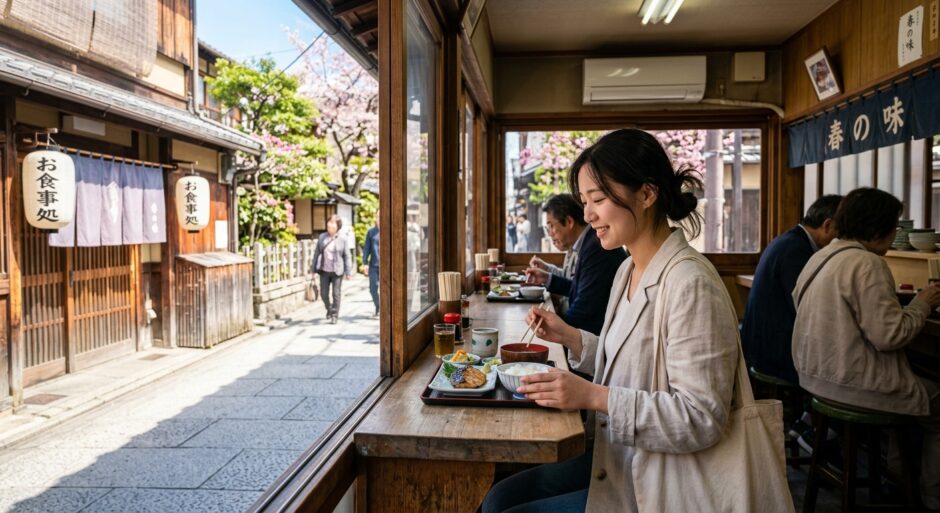
- ✅ Counter Culture: Most authentic solo spots are counter-only. If you see a row of stools, walk in!
- ✅ Timing Hack: Eat at 11:30 AM or 5:30 PM to beat the “Salaryman Rush.”
(Beginner Friendly)
🍱 The King of Solo Dining: Teishoku-ya (Set Meal Shops)
If you want to eat like a local Japanese person does every day, you need to find a Teishoku-ya. A Teishoku is a pre-set meal that follows the traditional Japanese nutritional balance of Ichiju-sansai (one soup, three sides). You get a main dish (like grilled fish, ginger pork, or tonkatsu), a bowl of fluffy rice, miso soup, and pickles.
Why it’s great for solo travelers: These shops are designed for efficiency. Many have ticket vending machines at the door, meaning you don’t even have to speak to order. You simply sit at the counter, hand over your ticket, and a feast appears in five minutes.
💡 Japan Hack: The Chain Winners
Can’t find a local mom-and-pop shop? Look for Ootoya (大戸屋) or Yayoiken (やよい軒). They are high-quality chains found near almost every major station, offering incredible value and English tablet menus!
👟 Tachigui: The Art of Standing and Eating
Feeling adventurous? Look for the sign 立ち食い (Tachigui). These are “standing-only” eateries. Traditionally found on train station platforms or tucked into narrow alleys, they serve Soba, Udon, and even high-end Sushi or Steak.
Because there are no chairs, the turnover is incredibly fast. It is the ultimate “no-judgment” zone for solo diners. You are there for one thing: the food. In Tokyo, Standing Sushi Bar (Uogashi Nihon-ichi) is a legendary spot where you can get chef-prepared nigiri for about $1 a piece while standing next to office workers on their lunch break.
📊 Solo Dining Style Comparison
Low Cost / Fast
Mid Cost / Relaxed
Higher Cost / Social
🏢 Depachika: The Gourmet Underground
If you’re too tired to sit in a restaurant but don’t want to settle for convenience store (conbini) food, head to the basement of any major department store (like Isetan, Mitsukoshi, or Daimaru). These are known as Depachika.
It’s a sensory overload of high-end bento boxes, yakitori skewers, fresh sashimi, and world-class pastries. You can curate your own 5-star meal and take it back to your hotel or a nearby park.
⚠️ Manner Alert! The “Discount” Rush
Around 7:30 PM (or an hour before closing), staff start slapping “Discount” stickers (30% to 50% off) on fresh food. It becomes a bit of a polite “scramble”—watch your elbows and be quick!
お一人様
(Ohitorisama)
“A party of one.” Use this when entering a restaurant: “Ohitorisama desu!”
🏮 Solo Izakaya Strategy: Don’t Be Intimidated!
Izakayas are often described as Japanese pubs, and while they are popular for groups, they are actually fantastic for solo diners—if you know the protocol. The secret? Look for the Counter (Kountā).
Sitting at the counter allows you to watch the chef grill your yakitori or prep your sashimi. It also signals to the staff that you’re a solo diner. Often, the chef might strike up a small conversation if they aren’t too busy.
💡 Identifying a “Solo-Friendly” Izakaya
📱 The Tech Hack: Forget Yelp, Use Tabelog
In the West, we rely on Google Maps and Yelp. In Japan, Tabelog is the undisputed king. However, there’s a catch: Japanese reviewers are harsh.
💡 Pro-Tip: The “3.5 Rule”
On Tabelog, a 3.0 is “good/average.” A 3.5 is “excellent and very famous.” Anything above 4.0 is likely a world-class restaurant that requires reservations months in advance. Don’t be afraid of a 3.1 rating!
🥢 Final Etiquette for the Solo Adventurer
To truly blend in like a Japan Hacks pro, remember these three quick tips:
- The Oshibori: Use the wet towel provided to clean your hands only, not your face.
- The Otoshi: At Izakayas, you’ll be served a tiny snack you didn’t order. This is the “table charge” (usually $3-$5). Don’t panic; it’s part of the experience!
- The “Sumimasen!”: Don’t wait for the server to come to you. Raise your hand slightly and call out “Sumimasen!” (Excuse me) when you’re ready to order.
Japan is perhaps the only country where “eating alone” is seen not as a lack of company, but as a dedicated pursuit of flavor. By stepping away from the ramen queues and into the world of Teishoku, Tachigui, and Depachika, you aren’t just eating—you’re living the Japanese lifestyle. Gochisousama deshita! (Thank you for the meal!)