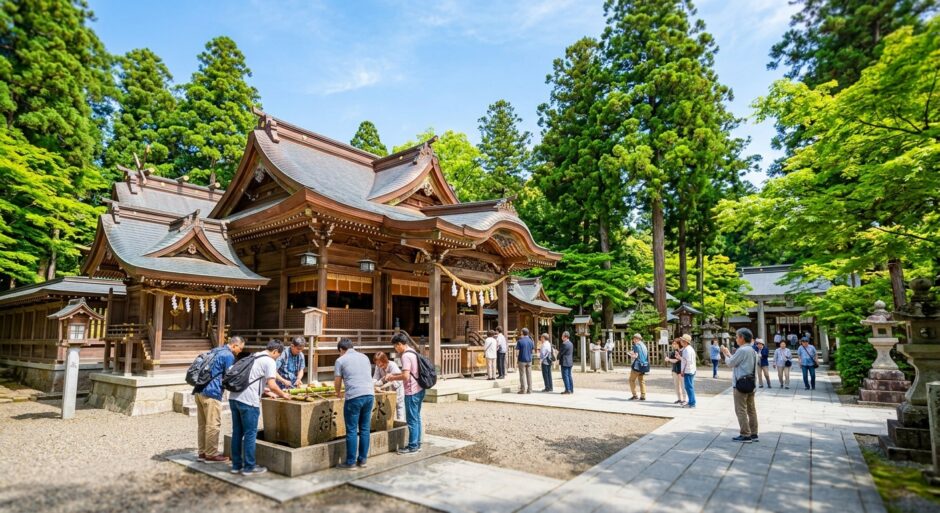

Whether you’re wandering through the neon-lit streets of Tokyo or the moss-covered forests of Kyoto, you’re bound to encounter the stunning vermillion gates of a **Shrine** or the majestic wooden halls of a **Temple**.
While these sites are breathtakingly beautiful, they aren’t just photo ops—they are active places of worship with centuries-old traditions. Nothing kills the “Zen” vibe faster than a loud tourist accidentally walking where they shouldn’t! 😱 🏯 🌸
Don’t worry, **Japan Hacks** has your back. We’re going to turn you into a cultural pro so you can visit these sacred spaces with confidence, grace, and total respect.
🇯🇵 Quick Hack Summary
- ✅ Identify Your Location: Torii gate = Shrine (Shinto); Large gate/Incense = Temple (Buddhist).
- ✅ Master the Bow: Always bow slightly when entering the main gate.
- ✅ The 5-Yen Rule: Use a 5-yen coin for good luck (Go-en).
- ✅ Quiet Please: Keep your voice down; treat it like a library or cathedral.
(Easy)
—
## 1. 🚶♂️ Walking Down the Dead Center of the Path
One of the most common mistakes happens before you even reach the main building. When you pass through a *Torii* gate (Shrine) or a *Sanmon* gate (Temple), you’ll see a long path called the *Sando*.
**The Mistake:** Walking right down the middle.
**The Hack:** Always stick to the sides (left or right). The center of the path, known as *Seichu*, is reserved for the deities (the *Kami*). Walking in the middle is considered “cutting off” the gods.
💡 Pro-Tip:
If you see locals walking on the left, follow suit. In some regions like Ise Grand Shrine, the “correct” side varies, but the rule of “stay out of the middle” is universal!
—
## 2. 💧 Fumbling the Purification Fountain (Temizuya)
Before you pray, you must purify. You’ll see a water pavilion with stone basins and bamboo ladles. This is the *Temizuya*.
**The Mistake:** Drinking directly from the ladle or putting your hands inside the main basin.
**The Hack:** Follow this specific 4-step sequence using only **one** scoop of water:
1. Hold the ladle in your right hand and wash your left hand.
2. Switch hands and wash your right hand.
3. Switch back to your right hand, pour a little water into your cupped left palm, and rinse your mouth (don’t swallow—spit discreetly into the drain below).
4. Tip the ladle vertically to let the remaining water wash down the handle, then place it back.
手水
(Temizu)
“Hand-washing” / Purification ritual
—
## 3. 👏 Clapping at the Wrong Time (Shrine vs. Temple)
This is the “Final Boss” of etiquette mistakes. Shrines and Temples have different rituals, and many tourists mix them up.
**The Mistake:** Clapping your hands at a Buddhist Temple.
**The Hack:**
* **At a Shrine (Shinto):** You clap twice to wake/greet the gods.
* **At a Temple (Buddhist):** You **DO NOT** clap. You simply press your hands together in silent prayer (*Gassho*).
### 📊 Ritual Comparison Guide
—
## 4. 🪙 Throwing Money Like a Fountain
When you reach the offering box (*Saisen-bako*), it’s customary to toss a coin.
**The Mistake:** Throwing the coin aggressively or using a 10-yen coin.
**The Hack:** Gently slide or toss the coin into the box. Why avoid 10 yen? In Japanese, “10” can sound like “To-en,” which means your luck is “far away.”
📊 The “Good Luck” Coin Ranking
Best Luck! 🌟
Average
—
## 5. 📸 Ignoring “No Photo” Signs Inside Buildings
Japanese shrines and temples are incredibly photogenic, but there are limits.
**The Mistake:** Snapping photos of the deity statue inside the main hall.
**The Hack:** Look for a sign that says **撮影禁止 (No Photography)**. Generally, you can take as many photos as you want of the grounds, the gates, and the gardens. However, taking photos *into* the altar area is often forbidden as it’s considered disrespectful to the spirit residing there.
⚠️ Manner Alert!
Never use a tripod or selfie stick without checking first. Many crowded temples like Kiyomizu-dera have banned them because they block the path for other worshippers.
—
## 6. 📖 Treating the “Goshuin” Book Like a Scrapbook
One of the coolest souvenirs you can get is a *Goshuin*—a hand-drawn calligraphy stamp unique to each temple and shrine.
**The Mistake:** Asking the monk to sign your personal notebook, a piece of paper, or a travel guide.
**The Hack:** You **must** buy a dedicated book called a *Goshuin-cho*. Calligraphy artists may refuse to sign anything else because the Goshuin is considered a sacred “certificate of visit,” not an autograph.
💡 Pro-Tip:
Have your Goshuin-cho open to the next blank page before you hand it over. It shows respect for the monk’s time!
—
## 7. 🧣 Dressing Too Casually (or Loudly)
While there isn’t a strict “suit and tie” dress code, these are religious sites.
**The Mistake:** Wearing beachwear, gym clothes, or shouting to your friends across the courtyard.
**The Hack:** Dress “Smart-Casual.” If you are visiting a major site like Meiji Jingu, try to keep your shoulders covered and avoid super-short shorts. More importantly, keep your volume at a “whisper” level.
—
## ⛩️ Final Checklist for Your Visit
Before you step through that Torii gate, remember the **Japan Hacks Triple-S Rule**:
1. **S**ilence: Keep your voice low.
2. **S**ides: Walk on the edges of the path.
3. **S**mile: Be polite to the staff and other visitors.
Visiting a shrine or temple is one of the most spiritual and calming experiences you can have in Japan. By avoiding these common mistakes, you’re not just being a “good tourist”—you’re actively participating in a beautiful, living culture.
—