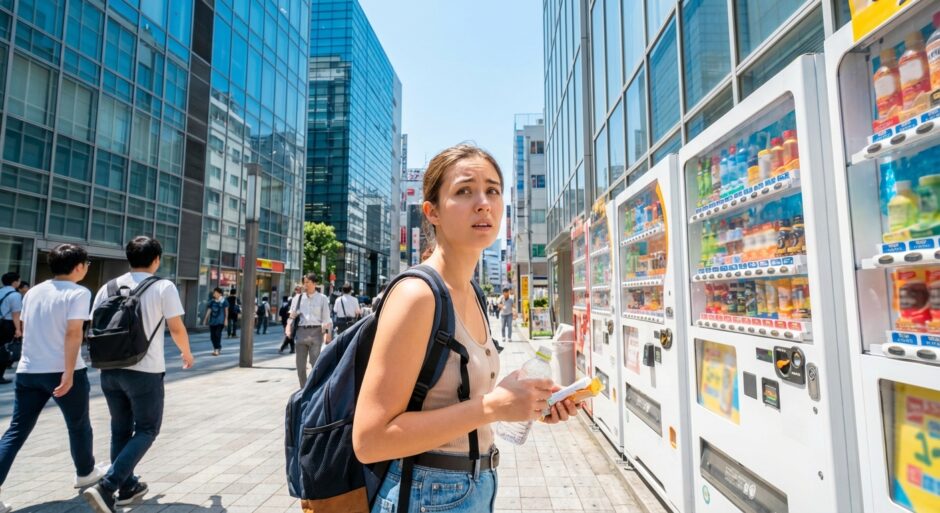

Welcome to the world’s cleanest paradox. You’ve just landed in Tokyo, you’re surrounded by pristine streets, yet you’ve been carrying an empty green tea bottle and a sticky crepe wrapper for the last forty-five minutes. Where are the trash cans?! 🌸🏯🍜
In Japan, “Where is the bin?” is the most common question tourists ask, right after “How do I use this bidet?” The lack of public waste bins is a deliberate part of Japanese urban planning and history. But don’t worry—you don’t have to spend your vacation as a walking dumpster. We’ve got the ultimate “Japan Hacks” to keep your pockets clean and your manners impeccable.
🇯🇵 Quick Hack Summary
- ✅ The Conbini Rule: Convenience stores are your primary waste stations.
- ✅ Vending Machine Logic: Only for bottles and cans—never paper!
- ✅ The “持ち帰り” (Mochikaeri) Mindset: Always carry a small plastic bag for personal trash.
- ✅ Train Station Platforms: Look near the vending machines on the platform, not the ticket gates.
(Easy once you know the spots!)
## 🕵️♂️ The Mystery: Why Are There No Trash Cans?
If you’re wondering why a country so obsessed with hygiene doesn’t have bins every ten feet, there are two main reasons.
1. **History:** Following the 1995 Sarin gas attack in the Tokyo subway, public trash cans were removed for security reasons to prevent hidden packages.
2. **Responsibility:** Japanese culture emphasizes the concept of **”Jiko Sekinin”** (self-responsibility). If you create waste, it is your responsibility to manage it until you get home.
## 📍 Where to Find the “Hidden” Bins
Finding a trash can in Japan is like a high-stakes game of hide-and-seek. Here is your cheat sheet on where the bins are actually hiding.
📊 Success Probability of Finding a Bin
95%
70%
10%
### 🏪 1. Convenience Stores (The Holy Grail)
7-Eleven, FamilyMart, and Lawson are your best friends. Most have bins located either just inside the door or right outside.
💡 Pro-Tip:
In major cities like Tokyo, some conbinis have moved their bins inside to prevent non-customers from dumping household waste. If you don’t see them outside, walk in and look near the ATM or the coffee machine!
### 🚉 2. Train Station Platforms
Don’t look for bins near the ticket barriers (gates); they are rarely there. Instead, head down to the actual train platforms. You will almost always find a row of sorted bins near the middle or ends of the platform.
### 🥤 3. Vending Machines (Liquid Only!)
Japan has a vending machine for every 23 people. Next to almost every machine is a bin. **HOWEVER**, these are strictly for bottles (PET) and cans. Do not try to stuff your bento box or tissue paper in here; it’s considered very rude.
ごみ
(Gomi)
“Trash” or “Waste”
## ♻️ The Art of “Gomi” Sorting
Finding the bin is only half the battle. Once you find one, you’ll be faced with a puzzle of 3 to 5 different slots. Sorting is a national sport in Japan.
⚠️ Manner Alert!
Do not put liquid into the trash. If you have a half-full bottle of tea, pour the liquid down a drain or toilet before recycling the bottle. Dumping liquids in the bin is a major “no-no” for sanitation workers.
## 🎒 Smart Hacks for the Pro Traveler
If you want to move through Tokyo like a local expert, you need a “Waste Management Strategy.”
### 🛍️ The “Wet Bag” Strategy
Always carry a few small, reusable plastic bags in your daypack. In Japan, most department stores or grocery stores give out small rolls of plastic bags near the checkout—grab one or two extra. Use these to store your trash until you reach your hotel or a convenience store.
### 🍢 Eat Where You Buy
The best way to avoid street food trash is to eat **at the stall**. In Japan, it’s actually considered rude to walk while eating (“tabearuki”). If you buy a skewer at a market like Tsukiji or Nishiki, stay at the stall to eat it. The vendor will almost always take the trash back from you when you’re finished.
### 🚬 For Smokers: Portable Ashtrays
You won’t find many ash trays on the street, and smoking while walking is illegal in many wards (like Shinjuku and Shibuya). Buy a “keitai haizara” (portable ashtray) at a 100-yen shop. It’s a small fireproof pouch that keeps the ash off the streets.
## 🏨 Handling Trash at Your Accommodation
If you are staying in an **Airbnb**, trash management is your biggest responsibility. Japanese neighbors are very sensitive to “Gomi” rules.
1. **Check the Calendar:** Different types of trash are picked up on different days (e.g., Burnables on Monday/Thursday).
2. **Use the Right Bag:** Many municipalities require specific, semi-transparent colored bags.
3. **Don’t Cheat:** Putting plastic in the burnable bag can lead to the “yellow sticker of shame,” where the city refuses to pick up your trash and leaves it for all your neighbors to see.
## 🏁 Conclusion: Embrace the Cleanliness
While the lack of trash cans might feel like a trap at first, it’s the reason Japan remains one of the most beautiful places to explore. By following these hacks, you’re not just solving a personal problem—you’re participating in the “Omotenashi” spirit by keeping the country beautiful for the next person.
So, keep that empty bottle in your bag for now, head to the nearest Lawson, and enjoy the satisfaction of a perfect sort!