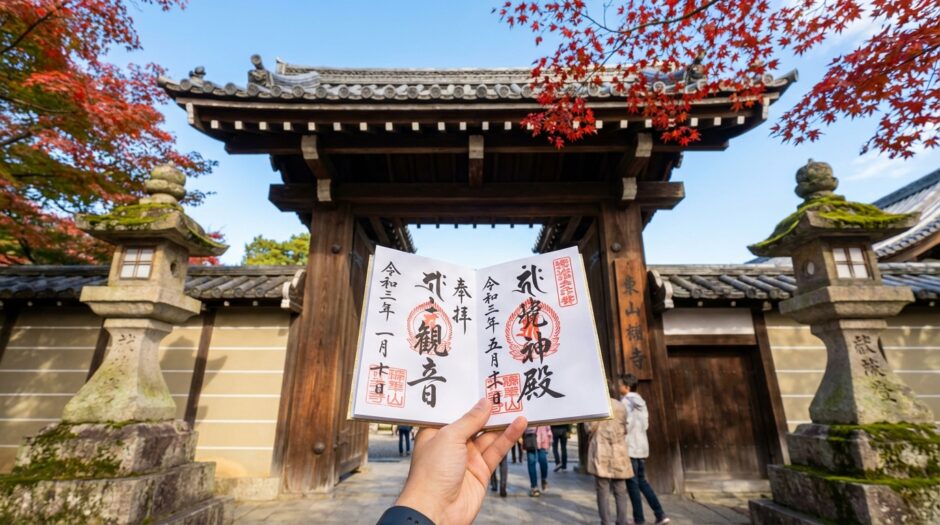

🌸 Forget fridge magnets and overpriced t-shirts. If you want a souvenir that carries the soul of Japan, you need to start your **Goshuin** journey.
Walking into a centuries-old temple, the smell of sandalwood incense in the air, you hand over a beautiful accordion-fold book. A monk, with focused precision, dips a bamboo brush into deep black ink and begins a rhythmic dance of calligraphy across the page. This isn’t just a stamp; it’s a sacred seal, a piece of art, and a spiritual “check-in” all rolled into one. 🏯✨
Welcome to the world of **Goshuin (御朱印)**. Whether you’re a history buff, an art lover, or just a traveler looking for a meaningful way to track your journey, this is the ultimate “smart” way to experience Japan.
🇯🇵 Quick Hack Summary
- ✅ Goshuin are NOT “stamps”: They are sacred seals. Treat them with respect.
- ✅ Get the Book: You MUST have a dedicated Goshuincho (stamp book).
- ✅ The Protocol: Pray first, then ask for the seal. Never vice-versa.
- ✅ Cost: Usually 300 to 500 JPY (have exact change ready!).
(Easy to start!)
—
## 🖌️ What Exactly is a Goshuin?
Originally, Goshuin were given to pilgrims who offered hand-copied sutras (scriptures) to a temple. Today, the process has been simplified, but the spiritual significance remains.
A standard Goshuin consists of:
1. **The Large Red Seal:** Usually the name of the deity or the temple.
2. **The Calligraphy:** Hand-brushed in “Sumi” (black ink), indicating the temple name and the date of your visit.
御朱印
(Goshuin)
“Honorable Red Seal”
—
## 📖 Step 1: Secure the “Goshuincho” (The Sacred Book)
You cannot—we repeat, **cannot**—collect these stamps in a regular notebook, a napkin, or your passport. You need a **Goshuincho**. These are special accordion-fold books designed with thick, absorbent paper that prevents the ink from bleeding through.
### Where to Buy One?
* **Temples/Shrines:** This is the most “pro” way. Buying a book from a temple like *Meiji Jingu* or *Senso-ji* gives you a beautiful cover unique to that location.
* **Stationery Stores:** Loft, Tokyu Hands, or specialized shops in Ginza offer trendy designs (think Pokémon, florals, or traditional Washi paper).
📊 Goshuin Budget Breakdown
¥1,500 – ¥3,000
¥300 – ¥500
—
## ⛩️ Step 2: The Ritual (Don’t Be “That” Tourist)
Getting a Goshuin is a religious act. Walking straight to the stamp counter is considered rude. Follow this “Japan Hacks” workflow to ensure you’re showing proper respect.
1. **Purify:** Stop at the *Chozuya* (water pavilion) to wash your hands.
2. **Pray:** Approach the main altar, offer a small coin (5 yen is lucky!), bow twice, clap twice (at shrines), and pray.
3. **Locate the Goshuin-jo:** Look for the sign that says **御朱印所**.
4. **Hand over your book:** Open it to the page where you want the stamp.
5. **Pay & Wait:** Usually, they will give you a numbered wooden token while the monk works their magic.
⚠️ Manner Alert!
Never take photos or videos of the monk or priest while they are writing. It is a meditative, sacred act. Also, wait until the ink is completely dry before closing your book—most places will give you a small slip of paper to place between the pages to prevent smearing.
—
## 🔍 Shrine vs. Temple: Know the Difference
While you can collect both in the same book, some purists prefer to keep a separate book for Shinto Shrines and Buddhist Temples.
—
## 🌟 Pro-Level Hacks for Your Goshuin Journey
### 1. The “Paper Goshuin” (Kakio-ki)
Sometimes, the calligrapher is out, or the stamp is “limited edition” on special colored paper. In this case, you’ll receive a loose sheet of paper. **Hack:** Carry a small glue stick in your bag to paste it into your book later!
### 2. Seasonal Limited Editions
Japan loves “Limited Editions” (Gentei). During Sakura season (Spring) or Momiji (Autumn), shrines often offer stunning Goshuin with gold leaf, floral illustrations, or 3D cutouts.
💡 Pro-Tip:
Download the app “Goshuin-noto” or check Omairi.com. These are like “Yelp” for stamps. They show you which temples have the most beautiful designs and warn you if they are currently unavailable.
### 3. The “Omotenashi” Small Talk
If you want to sound like a local when handing over your book, use this phrase:
*”Goshuin o onegaishimasu”* (Goshuin, please). When receiving it back, a simple *”Arigato gozaimasu”* with a slight bow goes a long way.
—
## 📍 Top 3 Spots to Start Your Collection
1. **Senso-ji (Asakusa, Tokyo):** The “classic” first stamp. It’s iconic, bold, and powerful.
2. **Meiji Jingu (Harajuku, Tokyo):** Known for its elegant, clean aesthetic. The Goshuincho cover here is also very sophisticated.
3. **Kinkaku-ji (Golden Pavilion, Kyoto):** Not only is the temple stunning, but their calligraphy is famous for being incredibly artistic.
—
## 🌸 Conclusion: A Journey for the Soul
Collecting Goshuin isn’t about filling a book; it’s about the moments of stillness you find between the chaos of Tokyo and the crowds of Kyoto. Ten years from now, you won’t remember the plastic souvenir you bought, but you *will* remember the way the ink smelled and the quiet dignity of the monk who created a masterpiece just for you.
**Happy hunting, and remember: Respect the spirit, enjoy the art!**