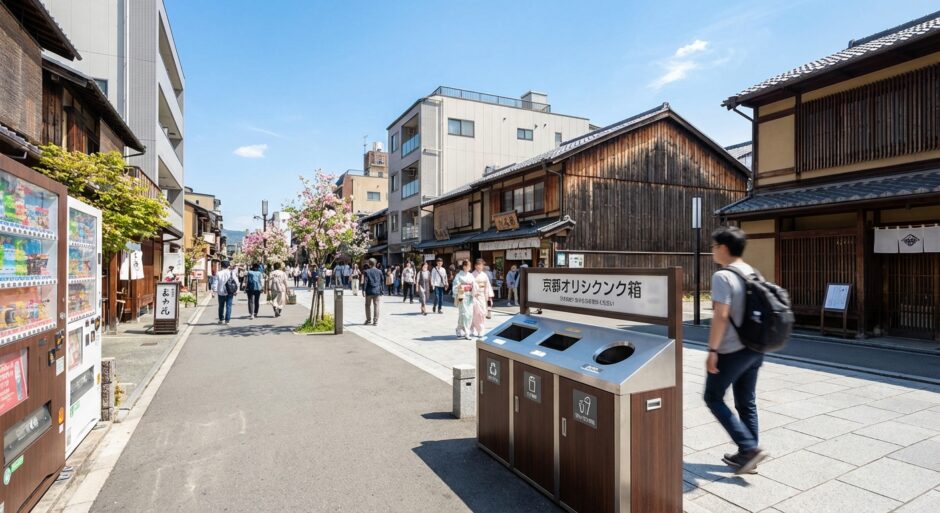

🌸 Welcome to Japan—a land of neon lights, world-class sushi, and the cleanest streets you’ve ever seen. But as you walk through Tokyo or Kyoto, clutching an empty bento box and a sticky boba cup, a panic begins to set in. You look left. You look right. **Where are the trash cans?**
It’s the great Japanese paradox: spotless sidewalks despite a near-total absence of public bins. For the unprepared traveler, this can lead to what we call the “Trash-Holding Marathon.” But don’t worry—at **Japan Hacks**, we’ve mastered the art of “trash hunting.” This survival guide will turn you from a frustrated tourist into a waste-management pro.
🇯🇵 Quick Hack Summary
- ✅ Target Convenience Stores: “Combini” are your primary disposal hubs.
- ✅ Vending Machine Secret: Only use these for bottles and cans.
- ✅ The “Ziploc” Strategy: Carry your own small bag for the day.
- ✅ Sorting is Sacred: Never mix paper with plastic.
(Moderate)
—
## 🕵️♂️ The Mystery: Why Are There No Trash Cans?
Before we find them, you need to understand why they disappeared. Up until the mid-1990s, Japan had bins everywhere. However, in **1995**, a domestic terrorist group (Aum Shinrikyo) carried out a sarin gas attack on the Tokyo subway system, hiding the chemicals in public trash cans.
To increase security, the government removed thousands of bins from public spaces. While the threat has long passed, the culture of “carrying your own trash home” (持ち帰り – *mochikaeri*) stuck. Today, keeping the streets clean is seen as a collective civic duty, not just a janitor’s job.
—
## 📍 Where to Find Them: Your Hit List 🏯
When you’re out and about, you need to know exactly where to aim. Here is the hierarchy of trash disposal in Japan.
### 1. The Holy Grail: Convenience Stores (Konbini) 🏪
Seven-Eleven, Lawson, and FamilyMart are your best friends. Most have bins located either just inside the entrance or right outside.
* **Pro-Tip:** It is considered polite to buy a small item (like a pack of gum or a drink) if you are using their bins for a large amount of trash.
### 2. Train Stations 🚉
Most major stations have trash cans located on the platforms or near the ticket gates. Look for a row of 3–5 bins labeled for different types of waste.
* **Warning:** Small, rural stations may not have them. Major hubs like Shinjuku or Osaka Station are your best bets.
### 3. Vending Machines 🥤
You are never more than 50 feet from a vending machine in Japan. Beside almost every machine is a bin specifically for **bottles and cans**.
* **Manner Alert:** Do NOT put paper, food scraps, or plastic bags in these. They have round holes designed specifically for containers.
⚠️ Manner Alert!
Shoving regular trash into a vending machine bottle bin is considered extremely rude and makes life difficult for the recycling collectors. Don’t be that person!
—
## 📊 Comparison: Where is Trash Disposal Easiest?
Not all locations are created equal. Use this chart to plan your “disposal stops” during your day trip.
📊 Trash Disposal Convenience
High Availability
Reliable
Rare
—
## 🚮 The Art of Sorting: “Gomi” Rules ♻️
In Japan, “trash” isn’t just “trash.” It’s a multi-category system. If you find a bin, you will likely see 3 to 5 slots. Mixing them is a major faux pas.
—
ゴミ箱
(Gomibako)
“Trash can” / “Waste bin”
—
## 🎒 The Smart Traveler’s “Trash Survival Kit”
If you don’t want to spend your afternoon hunting for a *Gomibako*, follow the **Japan Hacks Survival Kit** strategy:
1. **The Small Plastic Bag:** Always keep 2–3 small plastic bags (like the ones from grocery stores) in your backpack. Use one as your mobile trash bin and tie it off when full.
2. **Wet Wipes:** Since you’ll be carrying trash, things can get sticky. A pack of wet wipes is essential for cleaning your hands after disposing of a half-eaten snack.
3. **The “Eat-In” Rule:** When you buy street food (like Takoyaki or Yakisoba), stay near the stall until you finish. Most food stalls will have a small bin for their customers. Once you walk away, that trash is your responsibility!
💡 Pro-Tip: The Department Store Secret
Head to the basement! Japanese department stores (like Mitsukoshi or Daimaru) have incredible food halls (Depachika). These areas almost always have clean restrooms with trash bins nearby, or dedicated recycling stations for the food packaging they sell.
—
## 🏮 Etiquette Check: Don’t Be “That” Tourist
We’ve all seen it: a pile of coffee cups left on top of a random street bollard or tucked into the handlebar of a parked bicycle. **Don’t do it.**
Japanese culture prizes *Omotenashi* (hospitality) but also *Meiwaku* (avoiding being a nuisance to others). Leaving your trash in a public space is considered a major lack of character. If you can’t find a bin, the rule is simple: **Take it back to your hotel.** Your hotel room is the one place where you have a guaranteed trash service!
## 🏁 Conclusion
Finding a trash can in Japan is like a mini-game. It requires strategy, a keen eye for convenience stores, and a little bit of patience. By following this guide, you’ll keep your hands clean and respect the local culture of the beautiful country you’re visiting.
Remember: The streets are clean because everyone does their part. Now that you know the “hacks,” you’re officially part of the solution!