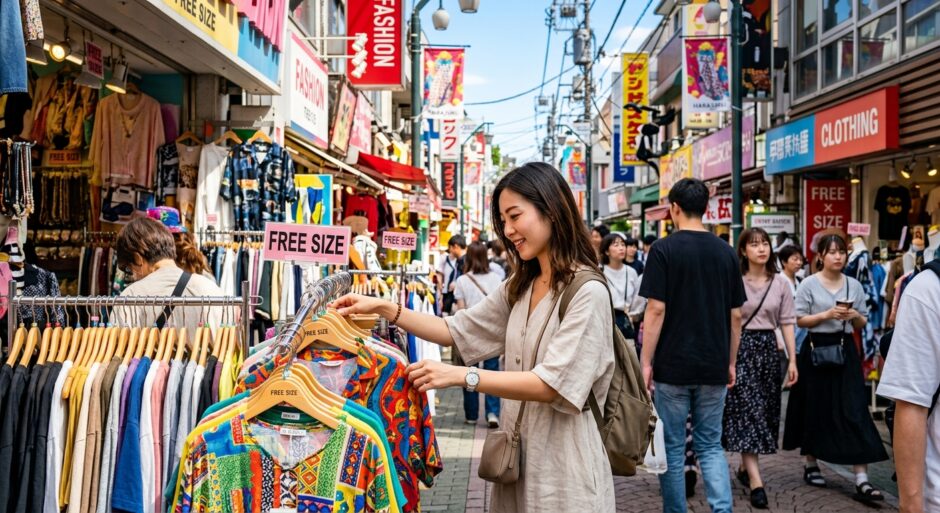

“`json
{
“title”: “The \”Free Size\” Trap: 5 Common Mistakes to Avoid When Shopping for Clothes in Japan”
}
“`
You’re walking through the neon-lit corridors of Shibuya 109 or the chic boutiques of Ginza. You spot the perfect minimalist coat or a trendy oversized sweater. You check the tag, and it simply says “F”. 🌸
“Free size!” you think. “It must fit everyone!” But five minutes later, in a cramped fitting room, you’re struggling to get your shoulders through the fabric. Welcome to the “Free Size” trap—a uniquely Japanese fashion phenomenon that catches even the most seasoned travelers off guard. 🏯 Shopping in Japan is an absolute dream for quality and style, but if you don’t know the local “hacks,” you’ll end up with a suitcase full of clothes you can’t actually wear.
📊 Japan Hacks: Shopping Dashboard
Topic: Japanese Apparel Navigation
Difficulty Meter:
Key Focus: Avoiding sizing errors, understanding fitting room etiquette, and mastering the “tax-free” system.
The “Free Size” Trap: 5 Common Mistakes to Avoid When Shopping for Clothes in Japan 🛍️
Japan’s fashion scene is legendary, blending traditional craftsmanship with avant-garde street style. However, the sizing logic is built on the average Japanese physique, which often differs significantly from Western standards. To ensure your shopping spree doesn’t turn into a series of unfortunate returns, let’s dive into the five biggest mistakes travelers make.
1. Believing “Free Size” Means “One Size Fits All” 📏
In most countries, “One Size” implies a garment has enough stretch or volume to accommodate various body types. In Japan, “Free Size” (often labeled as “F”) generally means “One size fits the average Japanese woman/man.”
Typically, a “Free Size” item is roughly equivalent to a US Small or a European 36. If you are taller than 165cm (5’5″) or have a broader athletic build, Free Size items—especially those without elastic—might feel restrictive in the shoulders and chest.
Global Size Comparison (Approximate)
= US Small/Medium
= US Extra Small
2. Entering the Fitting Room with Your Shoes On 👟
This is the cardinal sin of Japanese retail. In many Japanese boutiques, the fitting room area is treated with the same respect as a private home. There is usually a raised platform or a clearly marked rug where shoes are strictly forbidden.
🚨 MANNER ALERT: The Shoe Rule
Always take your shoes off before stepping onto the carpeted area of the fitting room. Point your shoes toward the exit (away from the mirror) as a sign of politeness. If you see a small tray or a pair of slippers, use them!
3. Ruining Clothes with Makeup (The Face Cover Rule) 💄
In Western countries, we often pull sweaters over our heads without a second thought. In Japan, keeping the merchandise pristine is a top priority. When you enter a fitting room, the attendant will likely hand you a thin, white non-woven fabric bag.
This is a face cover. You are expected to put it over your head before trying on tops to prevent foundation or lipstick from staining the collar. It feels a bit like being a friendly ghost, but it’s a non-negotiable part of the Omotenashi (hospitality) experience.
Japanese Word of the Day
試着 (Shichaku)
Meaning: Trying on clothes.
How to use: “Shichaku dekimasu ka?” (Can I try this on?)
4. Assuming Everything is Tax-Free Automatically 💸
Many travelers see the “Tax-Free” signs and assume they get 10% off everything at the register. However, there are two common pitfalls:
- The Minimum Spend: You usually need to spend at least 5,000 JPY (before tax) in a single shop to qualify.
- The Passport Requirement: You MUST have your physical passport with you (not a photo of it) to get the discount.
5. Ignoring the “Sleeve and Hem” Length 📏
Even if the waist fits, Japanese clothing is often cut shorter in the limbs. If you are blessed with long legs or arms, you might find that “Long Sleeve” shirts end up looking like 3/4 sleeves, and trousers often stop well above the ankle. This is why “A-line” dresses and wide-leg trousers are so popular in Japan—they are more forgiving for different heights!
💡 PRO-TIP: The Uniqlo Hack
Uniqlo in Japan offers complimentary or low-cost hemming for pants purchased in-store. If you find pants that fit the waist but are too long, ask for “Susonaoshi” (hemming). Often, they can finish it within an hour while you grab lunch!
Real-World Scenario: A traveler we spoke to recently at Lumine Est in Shinjuku shared her “Free Size” nightmare. She bought a beautiful ¥12,000 wool cardigan labeled “F.” It looked perfectly oversized on the mannequin. However, because the mannequin was only 158cm tall, the “oversized” look turned into a “crop top” on her 175cm frame. Lesson learned: Always check the measurements or try it on, no matter how baggy it looks on the hanger!
🤔 Frequently Asked Questions
Q: Can I return clothes if they don’t fit?
A: Many Japanese boutiques have strict “no return/no exchange” policies for international tourists, especially if you bought them tax-free. Always confirm before paying!
Q: Is “Large” the biggest size available?
A: In department stores, yes. For larger sizes (3L-5L), you may need to visit specialty shops like Sakazen or shop online at ZOZOTOWN.
Q: Why do shops ask to take my passport?
A: They don’t keep it! They need to scan it to process your 10% consumption tax refund instantly at the point of sale.
Shopping in Japan is more than just a transaction; it’s a cultural experience. By respecting the fitting room rules and being realistic about the “Free Size” label, you’ll find some of the highest-quality garments in the world that will remind you of your trip for years to come.