
“`json
{
“title”: “5 Common Tabearuki Mistakes to Avoid for a Seamless Japan Street Food Experience”,
“description”: “Master the art of Japanese street food with our guide to avoiding common ‘tabearuki’ mistakes. Learn the etiquette, trash rules, and local hacks for a perfect food tour.”,
“category”: “Travel Tips”
}
“`
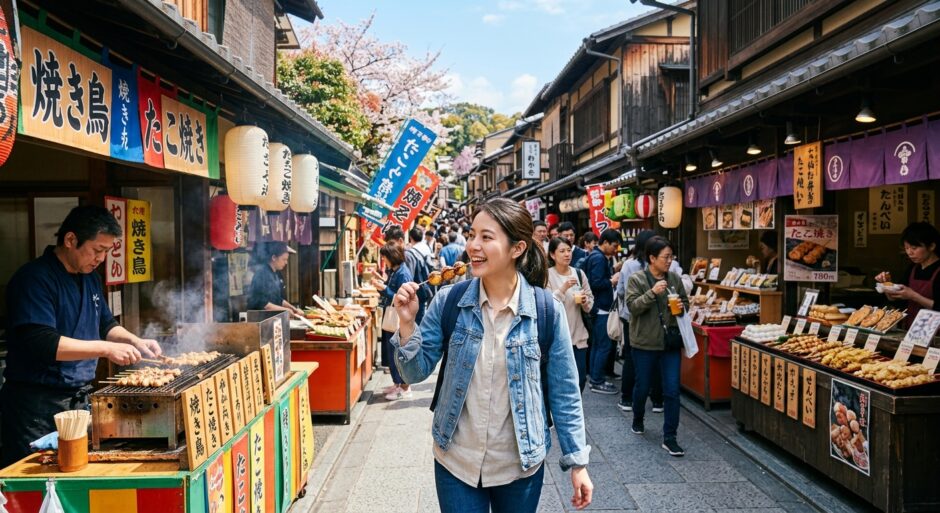
Picture this: You’re strolling through the neon-lit streets of Osaka or the historic alleys of Asakusa. The air is thick with the scent of savory Takoyaki, sweet Taiyaki, and smoky Yakitori. You grab a skewer, take a bite, and start walking… Stop right there! 🛑 You might have just committed the ultimate Japanese social faux pas. In Japan, “street food” doesn’t always mean “walking food.” 🌸🏯🍜
📊 Japan Hacks Dashboard: Street Food Edition
Experience Level: Beginner to Intermediate
Cultural Impact: High (Manners are everything!)
Success Rate: 100% if you follow this guide.
Social Nuance Meter:
5 Common Tabearuki Mistakes to Avoid for a Seamless Japan Street Food Experience 🍡
The term Tabearuki (食べ歩き) literally translates to “eat-walking.” While it sounds like a fun activity, the modern reality in Japan is a bit more nuanced. As tourism surges, many local municipalities and shop owners have introduced specific rules to keep the streets clean and the flow of traffic smooth. Here are the 5 biggest mistakes tourists make and how you can hack your way to being a “local expert.”
1. Walking While Eating (The “Literal” Mistake) 🚶♂️💨
It sounds counter-intuitive, but in Japan, tabearuki usually means “visiting different shops to eat,” not necessarily “walking while chewing.” Walking and eating is considered “shitsurei” (rude) because you risk bumping into people, spilling sauce on someone’s kimono, or creating a mess.
🚨 MANNER ALERT: The “Stay-Put” Rule
In places like Kamakura’s Komachi-dori or Kyoto’s Nishiki Market, there are official requests (and sometimes bans) regarding walking while eating. The correct way? Buy your food, stand directly in front of the stall or in a designated eating zone, finish it, and then move on.
🈯 Japanese Word of the Day
Tachigui (立ち食い)
Meaning: “Standing and eating.” This is the preferred method at street stalls and train station noodle shops. Embrace the “stand and savor” lifestyle!
2. Playing “Trash Can Roulette” 🗑️🎲
Japan is famous for being incredibly clean despite having almost no public trash cans. A common mistake is carrying a sticky skewer or an empty plastic tray for miles, eventually getting frustrated and tucking it behind a vending machine. Don’t do this. It’s a major headache for locals.
| The Trash Scenario | The Amateur Move | The Japan Hack ✅ |
|---|---|---|
| Empty Skewers | Search for a public bin (and fail). | Return it to the stall where you bought it. |
| Plastic Packaging | Stuff it into a full bin at a park. | Carry a small plastic “trash bag” in your daypack. |
3. Blocking the “Flow” in Narrow Alleys 🌊🚧
Street food hubs like Takeshita Street in Harajuku or Omoide Yokocho in Shinjuku are tiny. A group of four people stopping in the middle of the path to take a selfie with their rainbow grilled cheese creates a human traffic jam.
💡 PRO-TIP: The “Shoulder-to-Wall” Strategy
If you must check your map or take a photo, step as close to the shopfront or wall as possible. In Japan, Spatial Awareness is a superpower. E-E-A-T insight: In a busy market like Nishiki, shopkeepers actually have a “no-photo” policy in certain zones to prevent these exact bottlenecks.
4. Entering a Different Shop with “Outside Food” 🍦🚫
This is a big one. You buy a delicious Melonpan at one stall and then decide to walk into a nearby boutique or a different sit-down cafe. In Japan, bringing outside food or drink into another establishment is often strictly forbidden. Even carrying an open ice cream cone into a clothing store can earn you a polite but firm “Sumimasen!”
5. Forgetting the “Survival Kit” (Wipes & Coins) 👛🧼
Street food is messy. Mitarashi Dango is sticky. Karaage is oily. Unlike restaurants that provide an oshibori (wet towel), street stalls might only give you a single thin napkin.
🎒 The Tabearuki Survival Kit:
- ✅ Wet Wipes: Buy a “bit-pack” from 7-Eleven. Your fingers will thank you.
- ✅ 100 Yen Coins: Many old-school stalls are cash-only. Don’t be the person trying to break a 10,000 yen bill for a 200 yen skewer.
- ✅ Small Plastic Bag: For your own trash (as mentioned in Mistake #2).
Real-World Insight: In 2019, the city of Kamakura officially passed an ordinance requesting tourists not to eat while walking on Komachi-dori. While it’s not a “fined” crime, the social pressure is real. Shopkeepers reported that the sheer volume of spilled food and discarded bamboo skewers was damaging the local atmosphere. By standing still, you’re not just following a rule—you’re preserving the beauty of the city.
🤔 Frequently Asked Questions
Q: Is it okay to drink while walking in Japan?
A: Generally, drinking (water/soda) while walking is more socially acceptable than eating, especially in hot weather. However, it is still polite to step aside, finish your drink near a vending machine, and use the recycling bin located right next to it.
Q: What should I do with my skewer when I’m finished?
A: Always return it to the stall you purchased it from. They usually have a dedicated “skewer bin.” If you’ve moved too far away, wrap it in a tissue and keep it in your bag until you get back to your hotel.
Q: Where are the best places for “Tabearuki” culture?
A: For a friendly experience, try Togoshi Ginza in Tokyo (the longest shopping street), Nishiki Market in Kyoto, or the Dotonbori area in Osaka.
Mastering tabearuki is all about Omotenashi—respecting the hospitality of the shop owners and the comfort of fellow travelers. By avoiding these five mistakes, you’ll not only eat better but also experience Japan with the grace and savvy of a true local. Now go out there and get that Takoyaki! 🐙