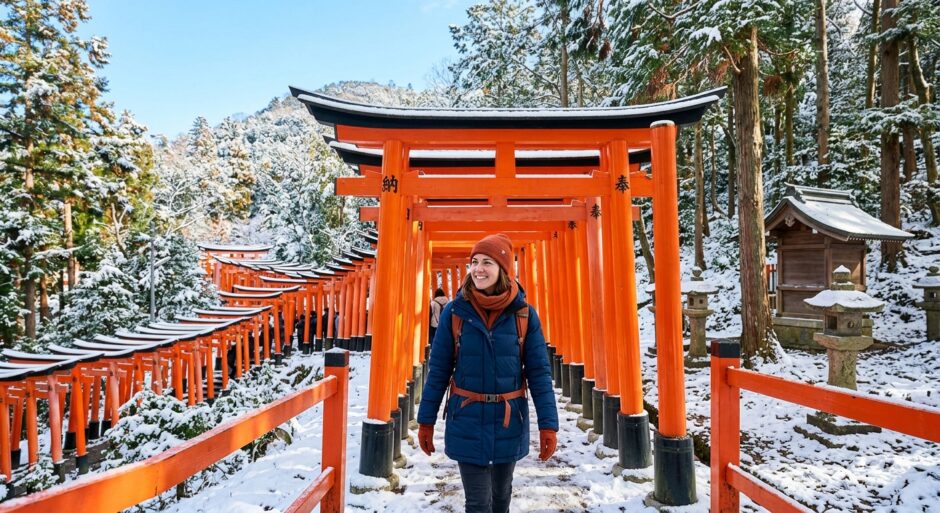

You’ve seen the photos: the majestic snow monkeys of Nagano, the golden glow of Kyoto’s Kinkaku-ji against a white backdrop, and the neon lights of Shinjuku reflecting off icy puddles. But what the travel brochures don’t tell you is that a winter trip to Japan is an endless battle of thermal extremes. ❄️🔥
One minute you are trekking through a sub-zero wind tunnel in Ginza, and the next, you’re trapped in a 26°C (79°F) subway car that feels like a literal sauna. If you rely solely on your heaviest parka and a single layer of “Ultra Warm” Heattech, you are going to spend your vacation oscillating between “shivering” and “sweating through your soul.”
Welcome to Japan Hacks. Today, we’re going beyond the basic Uniqlo shopping list to master the art of the “Japanese Layering System.” Let’s get you ready for the extremes. 🏯🍜❄️
🇯🇵 Winter Survival Dashboard
- ✅ The Core Strategy: Modular layering (The “On-Off” Method).
- ✅ Essential Gear: Heattech (specific levels), Kairo heat pads, and “Mufflers.”
- ✅ The Hidden Enemy: Over-heated public transport and department stores.
(Easy-ish)
🌡️ The Great Temperature Divide
Japan’s winter isn’t just cold; it’s inconsistent. Central heating in Japan is intense. Whether you’re entering a Combini (convenience store), a department store, or a JR train, the blast of hot air will hit you like a physical wall. This is the “Temperature Seesaw.”
📊 Average Winter Temperature Swings (Tokyo)
4°C (39°F)
24°C (75°F)
The gap is nearly 20 degrees Celsius! If you wear a heavy sweater under a heavy coat, you will overheat within five minutes of boarding a train, leading to damp base layers that make you even colder once you step back outside. The hack? Zip-ups and buttons over pullovers.
👕 Level Up Your Heattech Game
Everyone knows Uniqlo’s Heattech, but most tourists make the mistake of buying the “Ultra Warm” version for a city trip. Unless you are heading to Hokkaido for a snow festival, Ultra Warm is usually too much. It’s designed for standing still in sub-zero temperatures, not for walking 20,000 steps around Tokyo.
💡 Pro-Tip: The Tights Trick
In Japan, many locals wear Heattech tights (leggings) under their jeans. This is the ultimate hack for windy days in Osaka or Tokyo. Your legs are often the most neglected part of your winter outfit!
🔥 The Secret Weapon: Kairo (Heat Pads)
If you haven’t discovered Kairo, your life is about to change. These are small, disposable chemical heat pads available at every convenience store (7-Eleven, Lawson, FamilyMart) for about 30–100 yen.
There are two main types you need to know:
- Haru Kairo (貼る): The adhesive type. You stick these on your clothes (never directly on skin!). Stick one on your lower back or between your shoulder blades.
- 貼らない Kairo: The non-adhesive type. Keep these in your pockets to warm your hands.
ほかほか
(Hoka-hoka)
“Nice and warm” / “Toasty” (The feeling of a fresh steamed bun or a hot bath).
👟 Footwear: The “Ice and Tatami” Dilemma
Winter in Japan involves a lot of taking your shoes off. Whether it’s a traditional restaurant, a temple, or even some fitting rooms, you’ll be stepping out of your boots constantly.
⚠️ Manner Alert!
Check your socks! Since you will be removing your shoes frequently, ensure your socks are clean and hole-free. Also, avoid complicated lace-up boots that take 5 minutes to put back on—you’ll hold up the line and feel the pressure of a dozen polite Japanese people waiting behind you.
The Hack: Wear slip-on chelsea boots or sneakers with “no-tie” laces. More importantly, carry a pair of thick wool socks in your day bag. Temple floors are made of wood and polished stone; they are brutally cold in January. Putting a pair of thick socks over your regular ones when you enter a temple is a pro-traveler move.
👜 The “Essential” Winter Day-Bag
Because you’ll be peeling off layers and adding heat pads, your bag needs to be functional. Here is what a smart Japan traveler carries:
- A Lightweight Scarf (Muffler): Easy to remove and stuff in a bag. It protects your neck from the wind tunnels between skyscrapers.
- A Compact Umbrella: Winter in Japan isn’t just snow; it’s often “freezing rain.” A 7-Eleven umbrella is a rite of passage, but a sturdy compact one saves money.
- Lip Balm & Hand Cream: The air in Japan becomes incredibly dry in winter. Your skin will crack within 48 hours if you don’t hydrate. (Look for the brand “Yuskin” in drugstores—it’s magic).
- A “Dry” Plastic Bag: For your wet umbrella or to carry your shoes in temples that provide bags.
❄️ Conclusion: Embrace the Chill
Mastering Japan’s winter is all about flexibility. Don’t dress for the North Pole; dress for a journey that takes you from a 2°C street corner to a 25°C ramen shop. By utilizing Heattech levels strategically, leveraging the power of Kairo, and keeping your footwear “temple-ready,” you won’t just survive the Japanese winter—you’ll actually enjoy it.
Now, go grab a hot “Corn Pottage” from a vending machine, stick a Kairo on your back, and go explore. The winter illuminations are waiting! 🌟