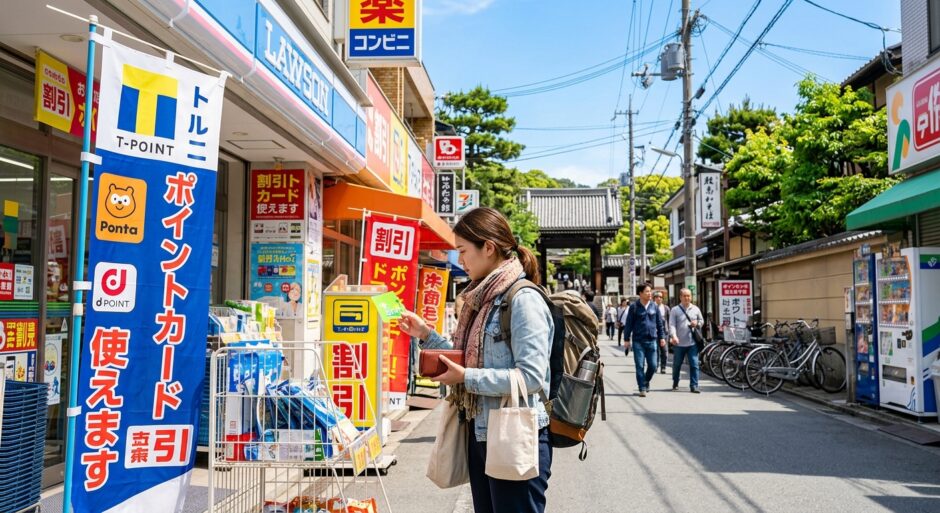

Ever stood at a Japanese convenience store checkout, and after you paid, the cashier looked at you expectantly, held up a card, and said something about “Pointo kaado?”
Most travelers simply shake their heads, say “No,” and move on. Big mistake. Huge. 🌸
In Japan, “Point Culture” (known as Poikatsu) is not just a hobby; it’s a national sport. Points are literally treated as cash. By ignoring these cards, you are essentially leaving 1% to 10% of your travel budget on the counter. Over a two-week trip involving electronics, high-end dinners, and daily konbini runs, you could be losing out on enough points to pay for a round-trip Shinkansen ticket or a luxury wagyu dinner. 🍜🏯
Welcome to Japan Hacks. Today, we’re going to stop the bleeding. Here are the 5 most common mistakes travelers make with Japanese point cards and how you can shop like a local pro.
🇯🇵 Quick Hack Summary
- ✅ 1 Point = 1 Yen: Almost every major point system treats points as direct currency.
- ✅ The “Big Three”: Focus on Rakuten, d-Point, and Ponta for the best coverage.
- ✅ Digital is King: Don’t carry plastic; use the apps to save space and time.
(Very Easy)
1. The “I’m Just a Tourist” Mindset 🛑
The biggest mistake is thinking these cards are only for residents. Many travelers assume that because they don’t have a Japanese phone number or address, they can’t participate. While some cards require a local address for physical mailing, the digital versions of the major players (d-Point, Rakuten, and Ponta) are often accessible to tourists.
When you buy a ¥50,000 camera at Yodobashi Camera or Bic Camera, you can often get 10% back in points. That’s ¥5,000 ($35 USD) sitting on a card that you could use immediately to buy a memory card, a case, or even lunch at the department store’s restaurant floor.
📊 Potential Savings (14-Day Trip)
¥200,000
¥10,000 ($70 Saved)
2. Ignoring the “Big Three” Ecosystems 🌍
Many travelers get overwhelmed by the dozens of different cards. The mistake is trying to collect everything. Instead, you should focus on the “Big Three” that are accepted almost everywhere.
ポイ活
(Poikatsu)
“Point Activities” — The art of strategically collecting and using points to save money.
3. Forgetting to Register the Card 📲
You’ll often see physical point cards sitting in a basket near the register at Lawson or FamilyMart. You grab one, the cashier scans it, and you think you’re earning points. Mistake!
While the points technically accumulate on that piece of plastic, you usually cannot spend them until you register the card online with a Japanese account. If you just collect points on an unregistered card and leave Japan, those points are lost forever.
💡 Pro-Tip:
Download the “d-Point” app before you leave home. They have an English version specifically designed for global users, making it the most “tourist-friendly” point system in Japan. You can earn points at Lawson and various drugstores immediately!
4. Missing the “Triple Dip” Opportunity 🍦🍦🍦
The pros don’t just use a point card. They “Triple Dip.” This is where you maximize every single yen spent. Travelers often make the mistake of just using cash or just a credit card, missing out on layers of rewards.
The Triple Dip Strategy:
1. The Payment: Use a travel credit card that earns you miles or points back home.
2. The Point Card: Show your d-Point or Rakuten barcode before paying to earn 1%.
3. The App Bonus: Use an integrated app (like Mobile Suica or PayPay) that has its own internal reward system.
⚠️ Manner Alert!
Don’t be the person who holds up a long line at a busy Tokyo station trying to find your barcode. Have your point app open and ready before you reach the cashier. Efficiency is part of the local etiquette!
5. Letting Points Expire (The Final Mistake) ⏳
Many travelers think, “I’ll save these points for my next trip to Japan in two years.” Warning: Most Japanese points expire within 12 months if there is no account activity.
The best way to use points as a traveler is the “Earn and Burn” method.
Spent ¥100,000 at a department store on Monday? You now have ¥1,000 in points. Use those points on Tuesday at a convenience store to buy your breakfast and drinks. Never leave Japan with a balance on your point cards—treat them like “disappearing cash.”
How to Ask to Use Your Points:
When you are at the register and want to pay using your points, simply show your app and say:
“Pointo de shiharaimasu.” (I’ll pay with points.)
Bonus Hack: The Tax-Free + Point Card Combo 💎
Wait, can you get the 10% Tax-Free discount AND earn point card rewards?
The answer is: It depends.
At massive retailers like Bic Camera or Don Quijote, they often have “Coupon Campaigns” for tourists that give you 8% or 10% off (Tax-Free) PLUS an additional 3-7% discount if you use a specific credit card or coupon. Often, you cannot earn “Standard Points” on top of these massive discounts, but the coupon discount is almost always higher than the point rate anyway. Always ask: “Tax-free and points, okay?”