
🌸 The IC Card Trap: How to Master Eki-naka Gate Logic and Avoid Common Travel Mistakes 🏯
You tap your card. The gate turns red. A symphony of “BEEP-BEEP” echoes through the station, and 50 commuters behind you let out a collective sigh. Welcome to the “IC Card Trap.” Let’s make sure it never happens to you again. 🍜
🇯🇵 Quick Hack Summary
- ✅ Entry-Exit Logic: Every “In” must have a corresponding “Out” at a different station.
- ✅ Minimum Balance: Most gates won’t let you in if you have less than the minimum fare (usually ¥140–¥160).
- ✅ The Eki-naka Loophole: Entering a station just for shops? You need a “Nyujoken” (Admission Ticket), not a standard tap.
(Moderate)
🚉 The Invisible Logic of the Ticket Gate
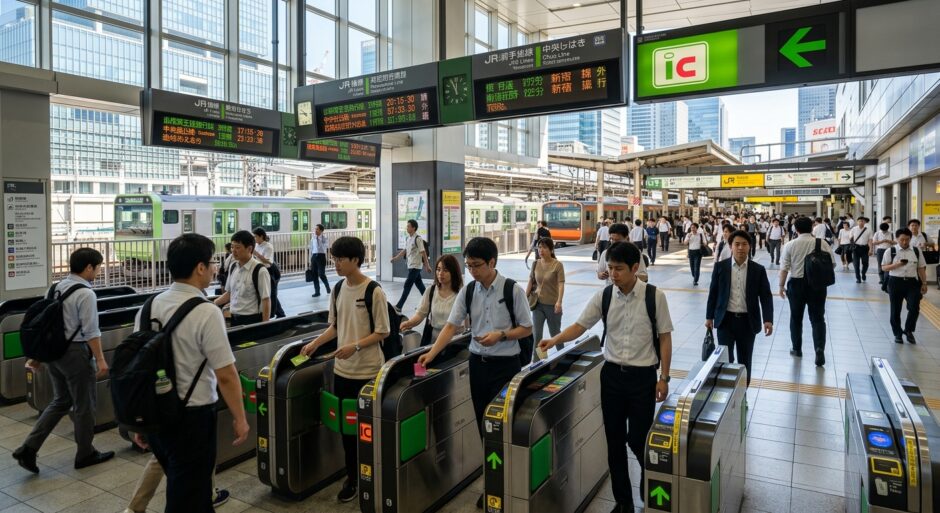
In many countries, transit cards are simple “stored value” cards. In Japan, the IC card (Suica, Pasmo, Icoca) is a highly sophisticated state-machine. When you tap at the Kaisatsu (ticket gate), the system records your entry station and time. The gate logic expects a linear journey. If you break this sequence—by trying to exit the same station you entered, or by jumping over a gate—your card will be “locked.”
📊 Time Lost Dealing with Gate Errors
0.5 Seconds
3–5 Minutes
*Estimate includes waiting for the station attendant and explaining the issue.
🛍️ The “Eki-naka” Dilemma: Shopping vs. Traveling
“Eki-naka” (inside the station) is a paradise. Stations like Tokyo, Shinjuku, and Kyoto are home to world-class bakeries, ramen shops, and souvenir boutiques that exist behind the ticket gates.
The Trap: You want to buy a specific melon pan at Tokyo Station. You tap your Suica, walk in, buy the bread, and try to tap out at the same gate. BEEP! The gate stays shut. Why? Because the system thinks you haven’t traveled anywhere. It cannot calculate a “zero-distance” fare.
💡 Pro-Tip: The Admission Ticket
If you only want to go inside for shopping, buy a Nyujoken (Admission Ticket) from the paper ticket machine. It costs about ¥140–¥160. If you accidentally used your IC card, you must go to the manned window to have the staff manually deduct the admission fee and reset your card.
⚠️ Common “Gate Fail” Scenarios
📱 The Mobile Suica Battery Trap
Moving your Suica or Pasmo to Apple Wallet or Google Pay is a game-changer. However, it introduces a new variable: Battery Life. While modern iPhones have a “power reserve” mode that allows transit cards to work even if the phone is “dead,” this only lasts for about 5 hours after the battery hits 0%.
⚠️ Manner Alert!
Never stop moving the moment you cross the gate. Tokyo’s foot traffic is high-speed. If you stop to check your phone or map right at the exit, you will cause a collision. Walk at least 5-10 meters away from the gate before stopping.
精算機
(Seisan-ki)
“Fare Adjustment Machine” — Found right before the exit gates.
🚅 Transfers: The JR vs. Subway Wall
This is where even locals get tripped up. In cities like Tokyo, JR lines and Subway lines (Tokyo Metro/Toei) are different companies. Sometimes, a “transfer gate” exists where you don’t actually leave the station, but you pass through a gate to switch systems.
The Secret: If you see a Yellow Gate or a gate with multiple card readers, it’s a transfer gate. Just tap once. The system will “close” your JR trip and “open” your Subway trip simultaneously.
The Shinkansen Hack: When transferring from a local train to the Shinkansen, you usually have to insert your paper Shinkansen ticket into the slot FIRST, then tap your IC card while the ticket is still inside the machine. The ticket will pop out the other side. Forget the IC tap, and the gate won’t open because it doesn’t know how you got to the station!
💡 Expert Tips for a Flawless Commute
- Watch the Display: When you tap, the small screen on the gate shows your remaining balance. If it’s below ¥500, make a mental note to recharge at the next station.
- One Device Rule: Don’t keep a physical Suica card in your phone case if you also have Mobile Suica active. The gate will try to read both, get confused, and lock you out.
- The “Sumimasen” Strategy: If you are stuck, simply find the staff window and say “Sumimasen” while holding out your card. They see this 1,000 times a day and will fix it in seconds without judgment.
Mastering the ticket gates is your “rite of passage” as a Japan traveler. Once you understand that the gate is simply a logical calculator, you can navigate the busiest stations in the world like a local pro. Safe travels, and keep that IC card topped up!