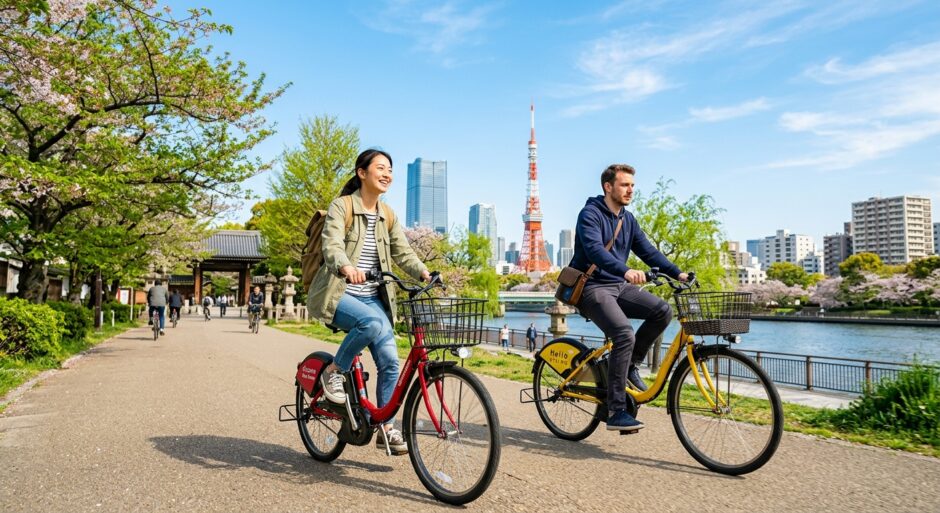

Picture this: You’re in Tokyo, the sun is setting over the Kanda River, and the subway is packed tighter than a bento box. You could squeeze into a train, or you could hop on a sleek electric bike and glide through the backstreets of Yanaka, discovering a hidden shrine that isn’t on any map. 🌸🏯🚲
In the battle for Japan’s “last mile,” two giants rule the streets: Docomo Bike Share and Hello Cycling. But which one deserves a spot on your precious smartphone home screen? Let’s dive into the ultimate showdown.
🇯🇵 Quick Hack Summary
- ✅ Docomo Bike Share: The king of central Tokyo (Chiyoda, Minato, Shinjuku). recognizable by their bright red frames.
- ✅ Hello Cycling: The national champion with a massive footprint in suburbs, Saitama, Yokohama, and Kyoto.
- ✅ Power Tip: Both use Electric-Assist (E-bikes), meaning hills are a breeze!
(Easy-ish)
*Registration takes 5-10 mins. Do it at your hotel, not at the bike rack!
🔴 The Red Giant: Docomo Bike Share
If you are staying in the heart of Tokyo—think Roppongi, Ginza, or Akihabara—you will see “The Red Bikes” everywhere. Operated by Japan’s largest telecom provider, Docomo, this service is integrated into the city’s urban fabric.
💡 Pro-Tip:
Docomo Bike Share allows you to register your Suica or Pasmo card as a physical “key.” Once set up, you don’t even need to open the app; just tap your card on the bike’s rear reader and ride!
Why Choose Docomo? 🚲
- 📍 Density: In central Tokyo (the 11-ward area), you are rarely more than a 3-minute walk from a port.
- 💳 Payment: Very reliable with foreign credit cards and offers “Day Passes” at many convenience stores.
- 🌉 Inter-Ward Riding: You can pick up a bike in Shinjuku and drop it off in Minato without any extra fees.
🟡 The National Contender: Hello Cycling
Hello Cycling (often seen with white or yellow branding) is the “modern” choice. Their app is generally considered more user-friendly for English speakers, and their fleet of bikes is often newer and more varied.
📊 National Availability (Estimated Ports)
8,000+ Ports
2,500+ Ports
*Docomo is highly concentrated in Tokyo; Hello Cycling is spread across Japan.
Why Choose Hello Cycling? 🚲
- 📱 Superior App UI: The Hello Cycling app is snappier, the map loads faster, and finding a bike feels more like using Uber.
- 🏪 Convenience Store King: They have a massive partnership with 7-Eleven. Most 7-Elevens outside the very center of Tokyo have a Hello Cycling station.
- 🛋️ Bike Quality: They often use Yamaha or Panasonic electric bikes, which feel a bit more robust and stable than the smaller-wheeled Docomo bikes.
自転車
(Jitensha)
“Bicycle”
⚔️ Head-to-Head: The Breakdown
⚠️ Know Before You Go: Manner Alert
⚠️ Manner Alert!
NO Illegal Parking: Unlike Lime or Bird scooters in the West, you cannot leave these bikes on the sidewalk. You must return them to a designated “port.” If the port is full, you cannot end your session. Always check the app for “Return Availability” before you arrive!
🛠️ How to Get Started (The Smart Way)
Don’t be the tourist standing in the rain trying to type credit card numbers while hovering over a bike. Register before you leave your hotel.
- Download the Apps: Get both. They are free to download and “pay-as-you-go.”
- Verify Your Phone: Both apps usually require a SMS verification. Most international numbers work, but doing this on your hotel Wi-Fi is safer.
- The “Map Check”: Open the app and look at your current location. If you see a sea of red dots, use Docomo. If you see yellow, use Hello Cycling.
- Check the Battery: Before you hit “Rent,” look at the physical bike’s screen. If the battery is under 20%, find another one. Tokyo hills are no joke!
🏆 The Verdict: Which One Wins?
Choose Docomo If…
You are staying in Minato, Chuo, or Chiyoda and plan to use the bike as a “shuttle” between tourist spots like the Imperial Palace and Tokyo Tower. It’s the ultimate Tokyo local tool.
Choose Hello Cycling If…
You are exploring Setagaya, Nakano, or cities like Kyoto and Osaka. It’s also the better choice for those who want a more modern app experience and larger, more comfortable bikes.
Whichever you choose, cycling is the absolute best way to see the “real” Japan. You’ll smell the bakeries, hear the school bells, and feel the rhythm of the city in a way a subway tunnel can never provide. Happy riding!