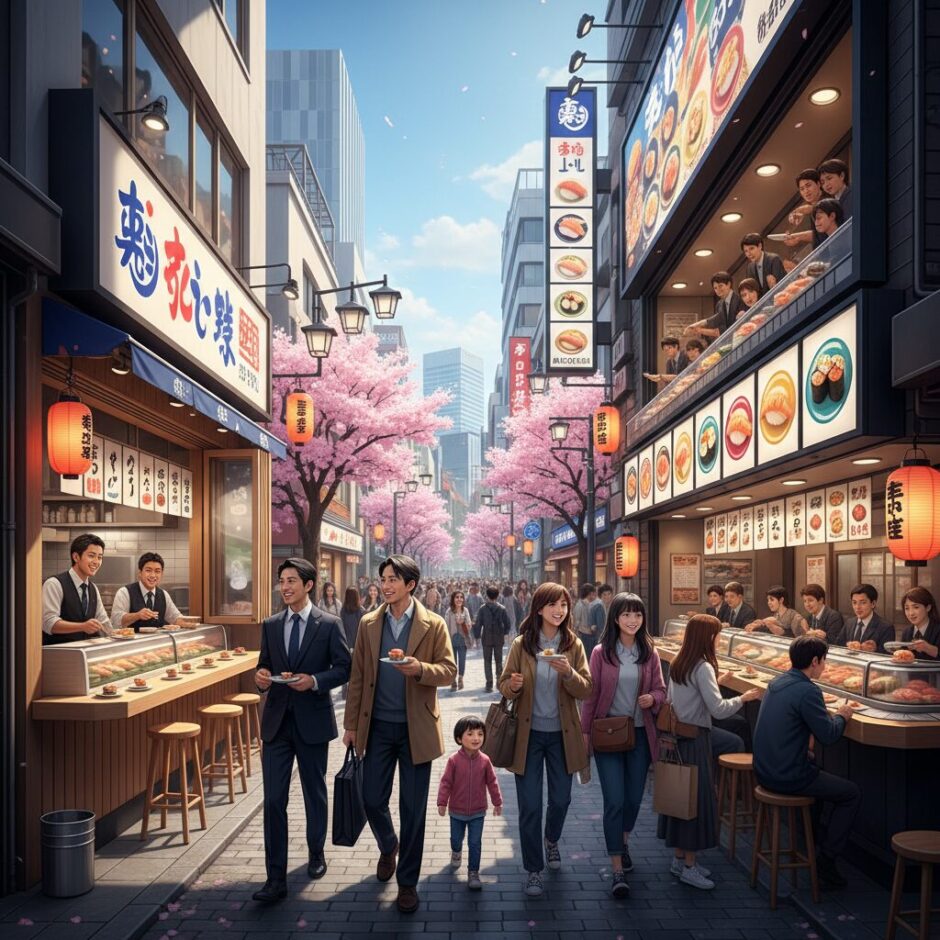

🍣 Standing Sushi Bars vs. Conveyor Belts
The Smart Traveler’s Guide to Quality and Value 🇯🇵✨
So, you’ve landed in Tokyo, Osaka, or Fukuoka, and your stomach is screaming for sushi. But as you walk down the neon-lit streets, you’re faced with a choice: Do you join the 45-minute queue for the famous “revolving” sushi chain, or do you duck into that tiny, hole-in-the-wall where everyone is standing up?
Welcome to the ultimate sushi showdown! At Japan Hacks, we don’t just want you to eat; we want you to eat like a local legend. Today, we’re breaking down the battle between Kaitenzushi (Conveyor Belt) and Tachiguizushi (Standing Sushi). One is a high-tech playground; the other is a fast-track to Michelin-level quality without the $300 price tag. Grab your chopsticks—let’s dive in! 🍱
🇯🇵 Quick Hack Summary
- ✅ Kaitenzushi: Best for families, groups, and those who want “sushi-tainment.”
- ✅ Tachiguizushi: Best for solo travelers and foodies seeking high-grade fish on a budget.
- ✅ The Secret: Standing bars often source the same fish as high-end Ginza shops.
(High)
🎠 The Conveyor Belt (Kaitenzushi): The Tech Wonderland
Kaitenzushi is the Japan you’ve seen on YouTube. It’s colorful, loud, and incredibly efficient. Chains like Sushiro, Kura Sushi, and Hamazushi have turned dining into a science. You sit at a booth, order via a tablet (usually with an English menu), and watch your plate zoom toward you on a mini-express train.
💡 Pro-Tip:
Never take the sushi that has been circling the belt for ages. Use the tablet to order “Fresh” pieces. They are made to order and sent directly to you, ensuring the seaweed (nori) is still crispy!
The appeal here isn’t just the fish; it’s the variety. You can get ramen, fried chicken, tempura, and even chocolate cake. It’s the perfect “safety net” if you’re traveling with someone who isn’t a raw fish fanatic.
🧍 The Standing Bar (Tachiguizushi): The Purist’s Paradise
Now, let’s talk about the real hack. Tachiguizushi (Standing Sushi) is a traditional style that has seen a massive revival. Why stand? Because no chairs means the restaurant can fit more people in a tiny space, lowering their overhead. They pass those savings directly to you in the form of **premium fish**.
In a standing bar, you are inches away from the chef. You order piece by piece. There is no conveyor belt, no robots—just a master and his knife. This is where you find the *Otoro* (fatty tuna) that melts like butter for a fraction of what you’d pay at a seated counter.
📊 Value Analysis (Per Piece)
¥120 – ¥180
¥200 – ¥400
¥1,500 – ¥3,000
*Tachiguizushi offers 80% of Ginza quality at 20% of the price.*
🆚 Head-to-Head Comparison
Which one fits your travel style? Let’s look at the specs:
旬
(Shun)
“Peak Seasonality”
In standing bars, always ask for the “Shun” fish. It’s the freshest catch of the day!
⚠️ Manner Alert: Don’t Be That Tourist!
Japanese dining has unwritten rules. In a standing bar, space is at a premium, so etiquette is even more important.
⚠️ Manner Alert!
- Don’t Drown the Rice: Dip the fish side into the soy sauce, not the rice. Soy-soaked rice falls apart and ruins the flavor.
- The Chopstick Rub: Rubbing your disposable chopsticks together is considered rude—it implies you think the restaurant uses cheap, splintery wood.
- Luggage Logic: Standing bars are tiny. Do not bring large suitcases inside. Use station lockers (Coin Lockers) before you arrive!
🏆 The Verdict: Which One Should You Choose?
If you have kids or you’re in the mood for a fun, stress-free dinner with lots of variety, Kaitenzushi wins every time. It’s a rite of passage for any visitor to Japan.
However, if you are a Smart Traveler—someone who values the quality of the ingredients over the “show”—you must try a Standing Sushi Bar. Look for chains like Uogashi Nihon-ichi in major stations like Shinjuku or Tokyo. You’ll be standing shoulder-to-shoulder with Japanese salarymen, eating sushi that would cost $15 a piece in New York or London for just $2. That is the ultimate Japan Hack.
Ready to test your taste buds? Whether you’re riding the sushi train or standing at the counter, remember: the best sushi is the one you share with a smile! Gochisosama-deshita!