
So, you’ve successfully installed LINE. You have the green icon on your home screen. You are ready to connect with Japan. But wait! 🛑
Just like bowing has angles and chopsticks have rules, LINE has a complex set of “unwritten laws” that govern how Japanese people interact. In Japan, LINE isn’t just a tool; it’s a social barometer. Use it wrong, and you might accidentally ghost a new friend or annoy a boss without even realizing it.
Why is everyone so obsessed with it? And how do you navigate the minefield of “Read Receipts” and “Stamps”? Japan Hacks is here to decode the digital etiquette of the rising sun. 🇯🇵📲
🇯🇵 Quick Hack Summary: LINE Survival Guide
- ✅ The “Read” Anxiety: The “Read” (Kidoku) tag is a promise. If you open it, you must reply.
- ✅ Stamps are Language: Japanese people use Stickers (Stamps) to soften the tone. Text alone can look angry.
- ✅ Work vs. Private: Never mix them unless invited. Using LINE for official business is often too casual for big companies.
- ✅ Group Dynamics: Leaving a group chat without a word is considered rude. You must announce your exit.
(High – Social IQ required!)
—
🤔 1. Why LINE? (It’s not just chat)
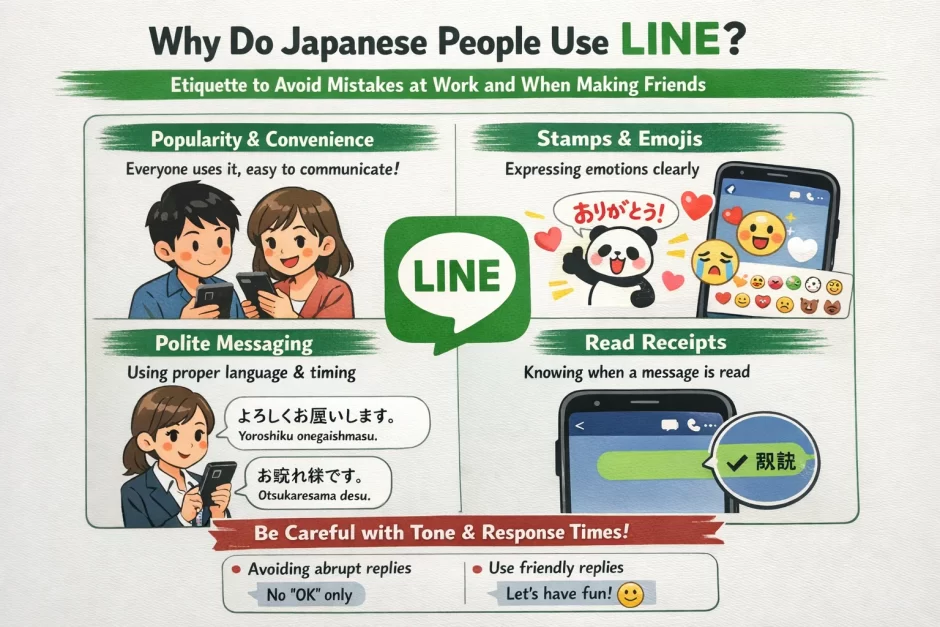
Why don’t Japanese people use WhatsApp or Messenger? Because LINE is a “Super App.”
In Japan, LINE is infrastructure. It’s how you pay for convenience store coffee (LINE Pay), how you read the news (LINE News), how you get coupons for dinner, and even how the government sends disaster alerts. Because everyone *has* to have it for daily life, it naturally became the default communication tool. To not have LINE is to be disconnected from modern Japanese society.
📊 Social Pressure to Reply Quickly
24 Hours
Variable (Whenever)
IMMEDIATE (Once read)
—
👀 2. The “Kidoku” Trap: Read Receipts
This is the #1 cause of anxiety in Japanese relationships. In LINE, you cannot turn off “Read” receipts. When you open a message, the sender sees the characters 既読 (Kidoku) next to the text.
In Japan, Kidoku means “I have received and understood this.” Therefore, if you open a message but don’t reply for 3 hours, the sender thinks, “They saw it, but they are choosing to ignore me.” This is a major social offense.
既読無視
(Kidoku-mushi)
“Ignoring a Read Message”
Literally “Read-Ignore.” Doing this to a superior or a partner is considered cold or angry.The Hack: Don’t open the chat until you have time to reply! Read the preview in your notifications instead.
—
🏢 3. Work Etiquette: Crossing the Line?
In Western countries, texting your boss might be normal. In Japan, the line between “Work” and “Private” is thick. However, many small businesses, restaurants, and part-time jobs (Baito) use LINE for shift scheduling.
⚠️ Manner Alert! Business Hours Only.
Sending a work-related LINE at 9:00 PM is considered harassment by many. Unlike email, which is passive, LINE alerts the phone directly. Unless it is a dire emergency, never LINE a coworker about work after hours.
—
🎨 4. The Art of “Stamps” (Stickers)
In the West, emojis 😂 are sprinkles on a cupcake. In Japan, LINE Stamps are the main course. A conversation without Stamps feels robotic, cold, and even angry.
Japanese is a high-context language. Saying “OK” can sound dismissive. But sending a Stamp of a cute bear bowing politely says, “I understand, I respect you, and I am enthusiastically agreeing.”
💡 Pro-Tip: Buy a “Keigo” (Polite) Pack
Don’t rely on the free default stickers. Spend 120 yen ($1) to buy a generic “Polite Animal” stamp set. Look for stamps that say “Arigato” (Thanks) and “Otsukare-sama” (Good work). Using these instantly makes you look like a culturally fluent insider.
The “Stamp End” Technique
How do you end a conversation in Japan? You don’t say “Bye.” You send a stamp. When the other person sends a stamp back, the conversation is officially over. It’s a digital bow.
—