
You’re at the register of a 7-Eleven, buying your morning coffee and egg sandwich. The cashier mumbles something fast: “Pointo kaado wa o-mochi desu ka?” (Do you have a point card?)
You panic, shake your head “No,” and pay with cash. 💸
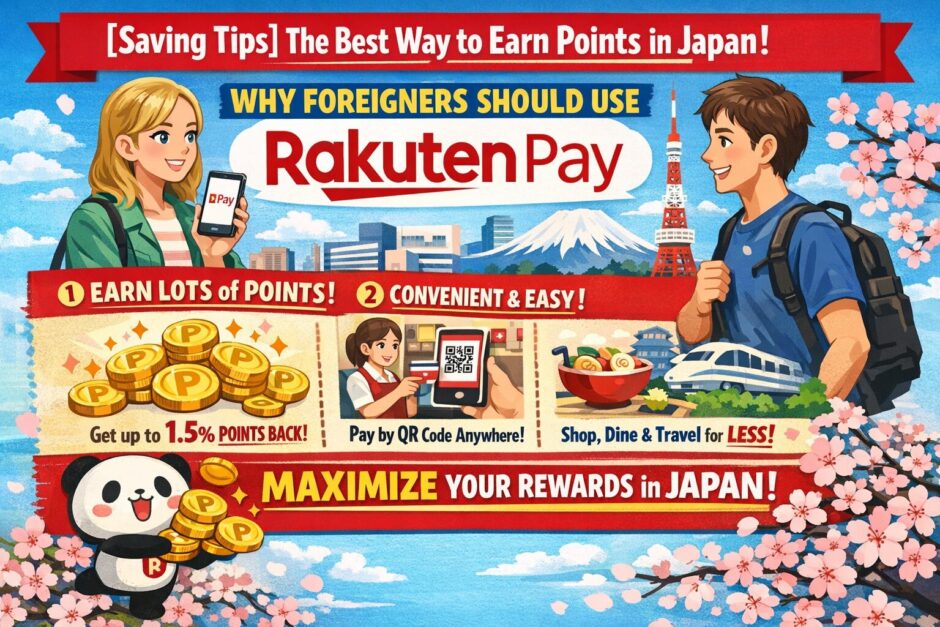
Stop doing this! You are literally throwing away free money. In Japan, “Points” are a second currency. While there are dozens of confusing apps (PayPay, d-Barai, Ponta), there is one king that rules them all, especially for savvy foreign residents and travelers: Rakuten Pay.
Here is why you should ignore the others and go all-in on the Red “R”.
🇯🇵 Quick Hack Summary: The “Poi-katsu” Strategy
- ✅ The Ecosystem: Rakuten Points are the most versatile. You can use them to pay for McDonald’s, pharmacy goods, or even your mobile bill.
- ✅ The “Double Dip”: You can earn points twice in one transaction (Point Card + Payment).
- ✅ The Return Rate: While Suica offers minimal returns, Rakuten Pay can yield 1.0% ~ 1.5% back on everything.
- ✅ The Barrier: Setting up the ID requires some translation help, but once active, it’s just a barcode scan.
(Moderate – Setup takes time)
—
💳 1. Cash vs. Suica vs. Rakuten Pay
Many travelers love Suica/Pasmo (IC Cards). They are fast and make the “ping” sound. But here is the secret: Suica basically pays you nothing. Unless you register for a complicated Japanese rail point system, you get 0 points for shopping with Suica.
Rakuten Pay, however, treats every purchase like a discount. If you spend 100,000 JPY (approx $700) a month on food/travel, look at the difference:
📊 Yearly “Free Money” (Points Earned)
0 JPY (Nothing)
~500 JPY (Negligible)
18,000 JPY ($120+)
*Assuming 1.5% return rate via Rakuten Card charge strategy over 1 year.
—
🍩 2. The “Double Dip” Technique (Niju-dori)
This is where foreigners get confused. When you go to a convenience store like FamilyMart or a drugstore, you can earn points twice in one transaction.
- Step 1: Show your “Point Card” Barcode inside the Rakuten App. The clerk scans it. (You get 0.5% – 1.0%).
- Step 2: Pay with the “Rakuten Pay” QR code. (You get another 1.0% – 1.5%).
If you just say “Pay with Rakuten,” the clerk might only scan the payment code, and you miss out on Step 1. You must show the Point Card first!
💡 Pro-Tip: “Limited Time Points”
Rakuten often gives you “Limited Time Points” (Kikan Gentei) for campaigns. These expire quickly! The best way to use them? Don’t save them. Go to the Rakuten Pay settings and check “Use Points First.” This way, your morning coffee is free every day until the points run out.
—
🛍️ 3. Where Can You Use It?
The biggest fear is “Will this shop accept it?” Rakuten Pay has massive coverage. Unlike some tourist-friendly cards that are hit-or-miss, the Red R is everywhere locals go.
—
🗣️ 4. How to Talk Like a Point Master
When you get to the register, the interaction speed is fast. You need to know the lingo to make sure you get your points without holding up the line.
ポイ活
(Poi-katsu)
“Point Activity” / Point Hunting
This is the cultural hobby of optimizing life to earn maximum points. “I am doing Poi-katsu!” is a legitimate excuse for choosing one restaurant over another.
⚠️ Manner Alert! Be Ready.
Do not wait until the cashier says the total to unlock your phone and find the app. Japanese registers are fast. Have your barcode on the screen before it is your turn. Fumbling for 30 seconds while people wait behind you is a major “Meiwaku” (nuisance).
—