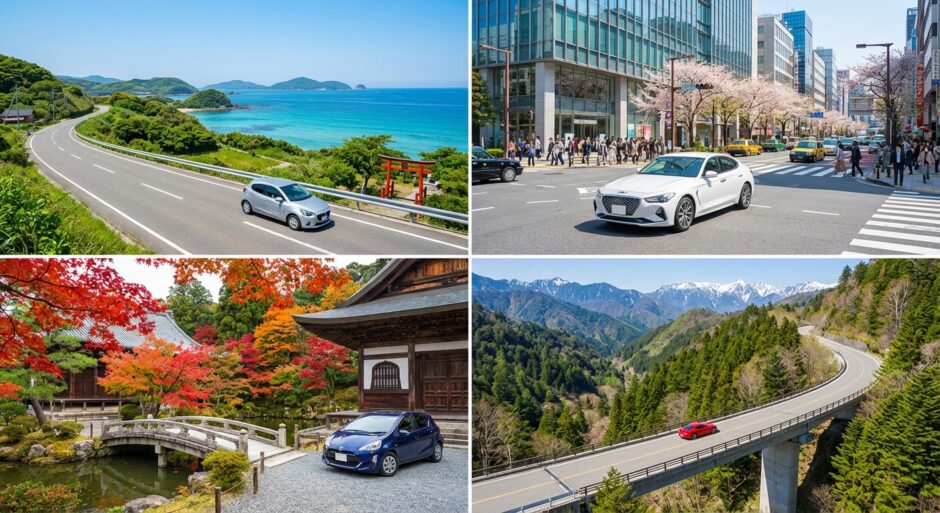

Driving in Japan is one of the most rewarding ways to see the country. While the Shinkansen is legendary, it won’t take you to the hidden shrines of Shikoku, the coastal roads of Okinawa, or the breathtaking flower fields of Hokkaido. However, the Japanese road system is a “polite minefield” for the unprepared. One wrong move can cost you hundreds of dollars—or worse, your legal right to drive.
As the Creative Director of **Japan Hacks**, I’ve seen too many travelers lose a day of their vacation at the rental counter. Let’s make sure that’s not you. 🚗💨
🇯🇵 Quick Hack Summary
- ✅ Paperwork: Your standard license is NOT enough. You need a specific IDP.
- ✅ ETC Card: Never drive on expressways without this magic card.
- ✅ Insurance: Always opt for the NOC (Non-Operation Charge) waiver.
- ✅ Rules: Japan has a zero-tolerance policy for alcohol and specific red-light rules.
(Moderate)
—
## 1. The IDP Disaster: Showing Up with the Wrong Paperwork 📄❌
This is the #1 mistake that ends a road trip before it begins. Japanese rental agencies are incredibly strict. If your paperwork is 1% off, they will refuse the rental, and you likely won’t get a refund.
Most travelers need an **International Driving Permit (IDP)**. But not just any IDP—it must be issued under the **1949 Geneva Convention**. If your country issues the 1968 version (like some European nations), it is invalid in Japan.
💡 Pro-Tip:
If you are from Switzerland, Germany, France, Belgium, Monaco, or Taiwan, an IDP is actually NOT valid. You must obtain an official Japanese Translation of your license from the JAF (Japan Automobile Federation).
—
## 2. Skipping the ETC Card (The “Toll Trap”) 💳🛣️
Japanese expressways (highways) are pristine, fast, and **incredibly expensive**. Driving from Tokyo to Kyoto can cost over $100 in tolls alone.
Most rental cars come equipped with an **ETC (Electronic Toll Collection)** card reader. However, the card itself is usually not included unless you ask for it.
**The Mistake:** Not renting the card for a few hundred yen. Without it, you have to use the “Cash” lanes, which are often crowded, and you’ll be fumbling for thousands of yen in coins while a line of polite but impatient Japanese drivers waits behind you.
📊 Toll Efficiency Comparison
3 Seconds
45+ Seconds
免許証
(Menkyosho)
“Driver’s License”
—
## 3. Ignoring the “NOC” (Non-Operation Charge) 🛡️⚠️
When you rent a car in Japan, you’ll see a basic insurance option. You might think, “I’m a great driver, I’ll skip the extra coverage.” **Don’t.**
In Japan, if you get into even a minor scratch that requires the car to be sidelined for repairs, you must pay a **Non-Operation Charge (NOC)**. This is a flat fee paid to the rental company to compensate for the lost business while the car is in the shop.
* **If you can drive the car to the shop:** 20,000 JPY (~$135)
* **If the car must be towed:** 50,000 JPY (~$340)
Many “Full Coverage” plans do **not** include the NOC waiver unless you specifically select the “Premium” or “Safety” pack.
📊 Potential Cost of a “Minor Scratch”
$0
$340+
—
## 4. Parking Where You Shouldn’t (The $200 Mistake) 🅿️🚫
Parking in Japan is a science. In cities, there is no such thing as “free street parking.” If you leave your car on a side street in Tokyo or Osaka for 10 minutes, you risk a massive fine and a yellow sticker on your windshield.
**The Coin Park Trap:** Most Japanese parking lots are “Coin Parks” with automated locking plates that rise under your car.
**The Mistake:** Drivers sometimes misinterpret the pricing. Look for **最大料金 (Saidai Ryokin)**, which means “Maximum Price.” If you don’t see this, the meter will keep ticking every 15-20 minutes, which can lead to a $50 bill for a few hours of sightseeing.
⚠️ Manner Alert!
Never park in front of a private residence or a convenience store (Konbini) for longer than it takes to shop. Konbini owners are known to call tow trucks quickly for travelers using their lot as free sightseeing parking.
—
## 5. Traffic Rule “False Friends” 🚦🇯🇵
Japan drives on the **left side** of the road, but that’s not the only difference. Several rules catch Western drivers off guard:
1. **No Right Turn on Red:** Unlike the US (Right on Red) or other countries, a red light in Japan means a total stop. You cannot turn left or right until the light is green or a green arrow appears.
2. **Train Tracks:** You **MUST** come to a complete stop before crossing any railroad tracks, even if the gates are up and there’s no train in sight. Failing to do so is a common traffic ticket for tourists.
3. **Zero Alcohol Tolerance:** The legal limit in Japan is effectively **0.00%**. If you have one beer and get behind the wheel, you are facing prison time, massive fines, and immediate deportation. Even passengers can be held liable for “allowing” a person to drink and drive.
満タン
(Mantan)
“Full tank” (Say this at the gas station: “Regular, Mantan de!”)
—
## Final Bonus Hack: MapCodes vs. Google Maps 📍
In rural Japan, Google Maps can sometimes lead you down “roads” that are actually narrow rice paddy paths intended for tractors.
**The Hack:** Use **MapCodes**. Every square inch of Japan has a unique numeric MapCode. Most Japanese car GPS systems allow you to input these numbers. They are far more accurate than typing in addresses (which are notoriously confusing in Japan). You can find MapCodes for most tourist spots on sites like *Japan-Guide* or by using the *Mapion* app.
💡 Pro-Tip:
When returning your car, you must show a receipt from a gas station within 5km of the rental office to prove you actually filled it up. Don’t throw that receipt away!
—
### Ready to hit the road?
Driving in Japan is an incredible experience. The drivers are generally patient, the roads are high-quality, and the views are unmatched. By avoiding these five costly mistakes, you’ll save money, stay out of legal trouble, and enjoy the true *Omotenashi* of the Japanese countryside.