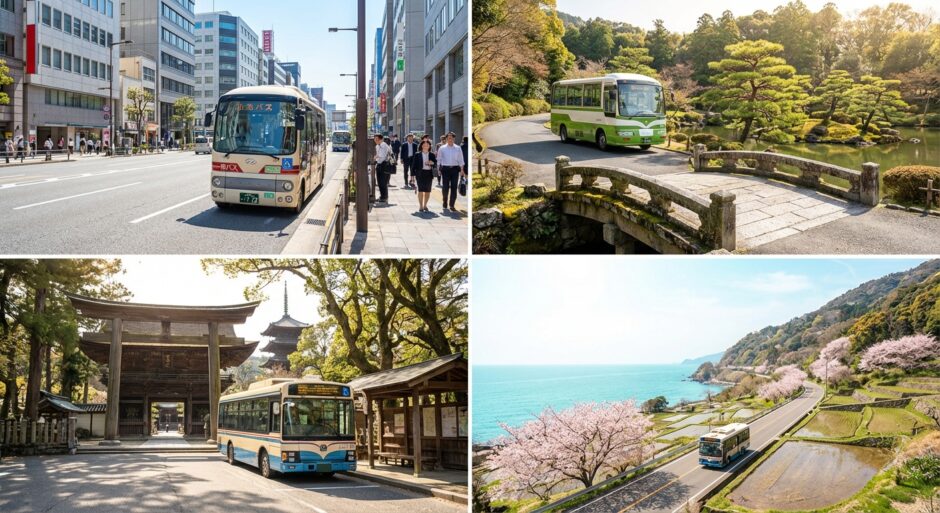

# Don’t Get Stranded: 5 Critical Mistakes to Avoid on Japan’s Local Bus Lines 🚌🌸
So, you’ve mastered the Tokyo subway. You can navigate Shinjuku Station without breaking a sweat, and you’ve even figured out which car on the Yamanote line is closest to the exit. You’re feeling like a pro. But then, you decide to venture out—maybe to the rolling hills of Hakone, the hidden temples of Kyoto, or the snowy peaks of Nagano. You see a local bus, hop on, and suddenly… **total confusion.**
Local buses in Japan are a completely different beast compared to the streamlined subway systems. They operate on their own logic, have unique payment systems, and can be the difference between a magical day trip and being stranded on a dark mountain road. At **Japan Hacks**, we don’t want you to be the traveler frantically waving a 10,000-yen note at a confused driver.
Let’s dive into the five critical mistakes that catch even seasoned travelers off guard!
🇯🇵 Japan Hacks: Local Bus Dashboard
- ✅ Key Point 1: Always check if you enter from the front or the back.
- ✅ Key Point 2: “Seiri-ken” (Numbered tickets) are your receipt for distance-based fares.
- ✅ Key Point 3: Most buses cannot change 5,000 or 10,000 yen notes.
(Moderate)
—
## 1. Entering Through the Wrong Door (The “Kyoto Shuffle”) 🚪🏯
In many Western countries, you always enter at the front and pay the driver. In Japan? It depends on where you are.
In central Tokyo, most buses have a **flat fare**. You enter at the front, tap your IC card (Suica/Pasmo), and exit from the middle or back. However, the moment you step into Kyoto or more rural areas, the rules flip. You enter through the **middle/rear door** and exit from the front.
If you try to force your way through the front door when everyone else is trying to get off, you’ll create a bottleneck and get some very polite but very firm “Sumimasen” looks.
—
## 2. Forgetting Your “Seiri-ken” (The Little Paper of Fate) 🎟️✍️
When you enter a bus from the rear, you’ll often see a small machine spitting out tiny slips of paper with a number on them. This is the **Seiri-ken** (Numbered Ticket).
**Do not ignore this machine.**
This ticket tells the driver exactly where you got on. Since rural buses calculate fares based on distance, the driver needs that number to know how much to charge you. Even if you are using an IC card, you **must tap your card** on the reader near the entrance door when you get on, and then tap again at the front when you get off.
整理券
(Seiri-ken)
“Numbered Ticket” / “Numbered Slip”
**Mistake:** You lose the ticket.
**Consequence:** The driver may have to charge you the fare from the very first stop of the bus route, which could be triple what you actually owe!
—
## 3. Carrying Only “Big Bills” (The 10,000 Yen Trap) 💴💸
Japanese bus drivers do not carry a till full of change. Instead, there is a **money-changing machine** next to the driver. However, there is a massive catch: these machines almost exclusively accept **1,000 yen notes** and coins.
If you try to pay a 230-yen fare with a 10,000 yen note, the machine will spit it back out, and the driver will likely have to tell you to go change it at a convenience store—which is impossible once the bus is moving.
💡 Pro-Tip:
The “Exchange” vs. “Payment” distinction: The machine near the driver usually has two functions. One slot is to exchange a 1,000-yen bill into coins. The other slot (or plastic tray) is to pay the exact fare. You must exchange your bill first, then drop the exact change into the fare box. It does not automatically give you change back from your payment!
—
## 4. Misreading the Timetable (Weekdays vs. Weekends) 📅📉
In the countryside, buses don’t come every 5 minutes. They might come once an hour—or twice a day. The biggest mistake travelers make is looking at the **Weekday (平日 – Heijitsu)** schedule when it’s actually a **Saturday/Holiday (土休日 – Dokyujitsu)**.
In Japan, “Holidays” aren’t just the big ones like New Year’s. There are many public holidays throughout the year, and buses will switch to the much sparser weekend schedule.
📊 Average Bus Frequency (Rural Japan)
4 per hour
1 per hour
**The “Last Bus” Warning:** Unlike trains that run until midnight, many local buses in sightseeing areas like Nikko or Hakone stop running as early as **5:00 PM or 6:00 PM**. If you miss that last bus, you might be looking at a very expensive 45-minute taxi ride back to your hotel.
—
## 5. Violating the “Silent Zone” Ethics 🤫🚫
Japanese buses are incredibly quiet. Even during rush hour with a bus packed to the gills, you could hear a pin drop. Many tourists, excited about their trip, talk loudly or—worst of all—take phone calls.
In Japan, talking on your cell phone on public transport is a major social taboo. It’s not just “frowned upon”—it’s considered deeply disrespectful to your fellow passengers.
⚠️ Manner Alert!
Set your phone to “Manner Mode” (silent) before boarding. If you must talk to your travel companion, use a “whisper voice.” Also, remember to take off your backpack and hold it in front of you or put it on your lap to save space for others!
—
## 🚀 Bonus Tip: The “Stop” Button Anxiety
Don’t be afraid to press the button! On Japanese buses, the driver will not stop at every station unless someone is waiting at the bus stop or someone inside the bus presses the **”Stop” (Tochaku)** button.
The moment the announcement for your stop plays, press that purple or yellow button immediately. If you wait until the bus is already passing the stop, the driver won’t stop for safety reasons, and you’ll have to walk back from the next one.
### Summary Checklist for a Stress-Free Ride:
* [ ] Check the door: Front or Back?
* [ ] Have 1,000 yen bills or a charged Suica.
* [ ] Take the numbered ticket (if applicable).
* [ ] Confirm the “Last Bus” time before you start your hike.
* [ ] Keep it quiet and enjoy the view!
Local buses are the gateway to the “Real Japan.” They take you to the hidden onsens, the family-run pottery shops, and the most breathtaking coastal views. By avoiding these five mistakes, you’ll travel with the confidence of a local and the heart of an explorer.