
The Smart Guide to Luggage Forwarding: How to Travel Japan Hands-Free
Picture this: You’ve just landed at Narita Airport after a 12-hour flight. You have two oversized suitcases, a carry-on, and a mission to reach your hotel in the heart of Shinjuku. You descend into the labyrinth of the Tokyo subway system during rush hour. Suddenly, the “dream vacation” feels like a weightlifting competition. You’re blocking doorways, struggling with stairs, and receiving polite but strained smiles from commuters.
There is a better way. In Japan, the secret to a stress-free journey isn’t a better suitcase—it’s not carrying one at all. Welcome to the world of Takkyubin (luggage forwarding), a system so efficient and reliable it feels like magic. Here at Japan Hacks, we believe the best way to see the country is hands-free. Here is everything you need to know to master the art of traveling light, even when you’ve packed heavy.
Quick Summary: Japan Hacks
- Takkyubin is King: Use services like Yamato Transport (the Black Cat) to move bags between cities for about $15–$25 per bag.
- Next-Day Delivery: Most luggage arrives the next morning. Same-day delivery is available in specific metro areas if dropped off early.
- Drop-off Anywhere: You can send bags from airport counters, hotel front desks, or almost any convenience store (7-Eleven, FamilyMart).
- Shinkansen Rules: New rules require reservations for oversized luggage on major bullet train lines; forwarding bypasses this headache entirely.
1. What is Takkyubin? (And Why You Need It)
In Japan, the term Takkyubin (pioneered by Yamato Transport) is synonymous with courier services. While they deliver everything from documents to chilled groceries, their luggage forwarding service is a godsend for travelers. The system is nationwide, incredibly punctual, and handles your belongings with the utmost care.
Why use it? Beyond the physical relief, many Japanese train stations—especially older ones—are notorious for having limited elevators and steep stairs. Furthermore, Japanese hotel rooms are famously compact; having your large suitcases arrive only when you need them saves valuable floor space.
Since 2020, if you are traveling on the Tokaido, Sanyo, or Kyushu Shinkansen (the Tokyo-Kyoto-Osaka route), you must reserve a specific seat with a luggage area if your bag’s total dimensions exceed 160cm. If you don’t reserve, you’ll be charged a 1,000 JPY fine and forced to move your bag. The Smart Hack? Forward your large bags and carry only a small backpack on the train.
2. Where and How to Send Your Bags
The beauty of the system is its accessibility. You are never more than a five-minute walk from a shipping point in urban Japan.
- At the Airport: Look for the “GPA” or “Yamato Transport” counters in the arrivals hall. You can send your bags directly to your hotel.
- At Your Hotel: Most mid-to-high-range hotels have a shipping desk or can handle it at the front desk. Simply tell the staff, “Takkyubin, onegaishimasu” (Luggage forwarding, please). They will provide the form and even measure your bag for you.
- At Convenience Stores (Konbini): If you’re staying at an Airbnb or a small hostel, head to the nearest 7-Eleven, FamilyMart, or Lawson. Look for the Black Cat logo (Yamato) or the Pelican logo (Sagawa). They accept pre-paid or pay-on-delivery shipments 24/7.
Smart Hack: If you arrive in the morning, your bags might even reach your Tokyo hotel by evening, allowing you to go straight from the airport to sightseeing.
3. Comparing Your Options: Is Forwarding Worth It?
To help you decide if you should lug, lock, or send your bags, here is a quick breakdown of the costs and convenience factors.
| Method | Est. Cost (Per Bag) | Pros | Cons |
|---|---|---|---|
| Luggage Forwarding | ¥2,000 – ¥3,500 | Total freedom; Door-to-door. | Requires 1-day lead time. |
| Coin Lockers | ¥500 – ¥900 | Good for day trips. | Large lockers are often full. |
| Carrying on Train | Free* | Immediate access to gear. | Stressful; Reservation required for big bags. |
4. Filling Out the Form Like a Pro
The shipping form (waybill) can look intimidating because it is primarily in Japanese, but most have English subtext. Here are the fields you need to know:
- Sender (From): Your current hotel name, address, and phone number.
- Receiver (To): The destination hotel name and address. Pro Tip: Always include your reservation name and check-in date in the “Notes” or “Reference” section so the hotel knows whose bag it is!
- Delivery Date & Time: You can specify a delivery window (e.g., “Morning,” “14:00–16:00,” etc.).
- Contents: Be specific (e.g., “Clothing,” “Souvenirs”). Do not just write “Luggage.”
5. The “Hands-Free Sightseeing” Hack
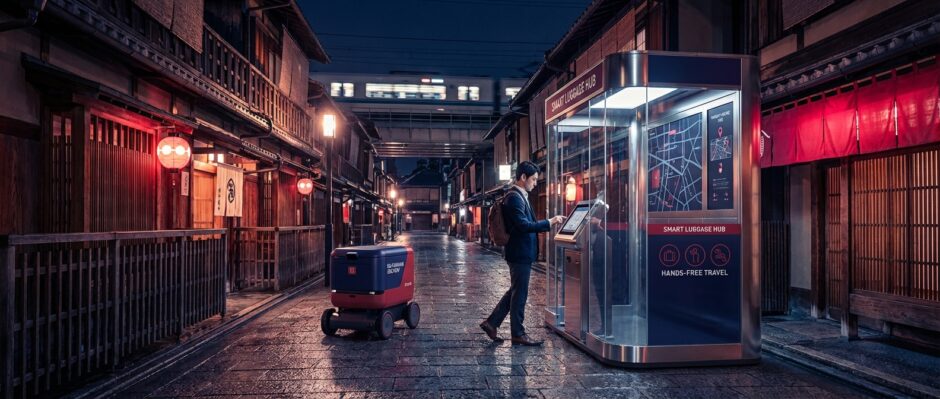
There is a specific service called “Hands-Free Travel” (look for the logo with a red suitcase and a checkmark) available at major stations like Tokyo, Kyoto, and Osaka. This is different from overnight forwarding. You drop your bag off at the station in the morning, and it is delivered to your hotel in that same city by the time you check in that afternoon. This is perfect for the “transition day” when you arrive in a new city before your hotel room is ready.
Since luggage forwarding usually takes 24 hours, always pack a small “overnight” backpack with your essentials (pajamas, toothbrush, change of clothes, chargers). Send your big suitcase from Tokyo on Monday morning; it will be waiting for you in Kyoto when you arrive Tuesday afternoon. This way, you travel on the Shinkansen with just your small backpack!
Conclusion: Experience the Freedom
In most countries, the idea of handing your luggage to a third party and expecting it to show up exactly where you want it the next day seems like a gamble. In Japan, it is the standard. By utilizing luggage forwarding, you reclaim your time, your energy, and your dignity. No more wrestling with suitcases on escalators or feeling the burn in your shoulders as you navigate the crowds of Shibuya.
The next time you plan your itinerary, don’t just think about where you’re going—think about how you’re getting there. Go hands-free, and experience Japan the way it was meant to be seen: light, fast, and smart.